Inheritance is the second of the five principles of natural selection introduced by Charles Darwin in The Origin of Species. While Darwin knew that inheritance plays a crucial role in natural selection, he was conflicted over how it works, noting –
“The laws governing inheritance are, for the most part, unknown.”
Niles Eldredge, of the American Museum of Natural History, introduced the V.I.S.T.A. framework to codify the principles of Darwin’s theory. The five structural principles of natural selection are variation, inheritance, selection, time, and adaptation.
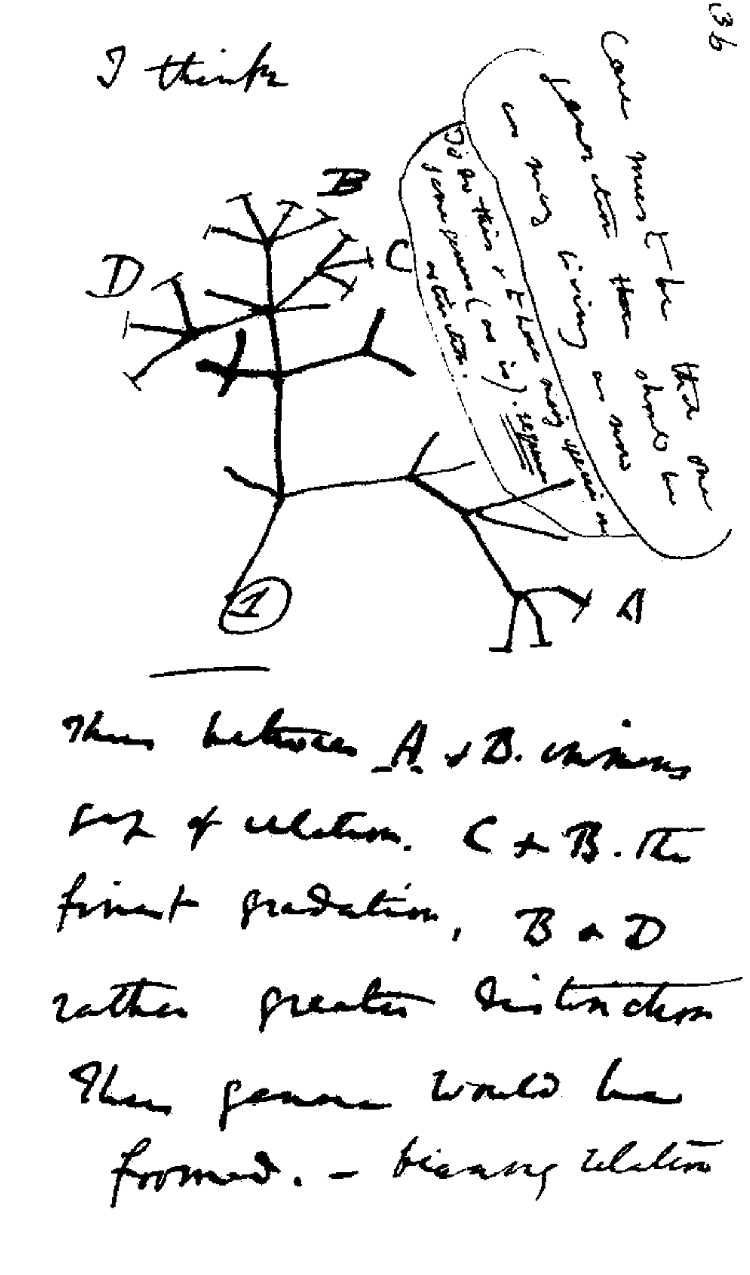
In 1837, nearly twenty years before publishing The Origin of Species, Darwin drew his first sketch linking inheritance to speciation (pictured left).
Inheritance Framework
Understanding Darwin’s framework of inheritance is essential for conceptualizing his theory. Inheritance plays a “chief part” in natural selection. As Darwin explains in The Origin of Species –
“The most important consideration is that the chief part of the organisation of every being is simply due to inheritance.”
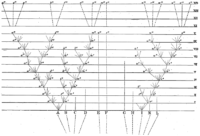 Inheritance is the biological process by which information is passed from one generation to the next. In the only diagram in The Origin of Species (pictured right), Darwin depicts how the principles of natural selection could lead to the formation of new species over time.
Using an imaginary original eleven species (A–L), only one species, designated “I”, is depicted as evolving into six distinct species over fourteen generations. As Darwin describes –
“The six descendants from (I) will form two sub-genera or genera… the six descendants from (I) will, owing to inheritance alone.”
The six new species emerging from species “I” over fourteen generations are depicted at the top of the diagram. These are denoted as n14, p14, w14, y14, u14, and z14. Each horizontal line, Darwin explains, “may represent each a thousand or more generations… up to the fourteen-thousandth generation.”
However, Darwin’s theory of inheritance never gained widespread acceptance among naturalists, even at the time. Neither had his proposed mechanisms of inheritance.
Process to Understand Inheritance
 Within his theoretical framework, Darwin explains how he processed his development to understand inheritance –
“By continuing the same process for a greater number of generations (as shown in the diagram in a condensed and simplified manner), we get eight species, marked by the letters between a14 and m14, all descended from (A). Thus, as I believe, species are multiplied, and genera are formed.”
In the only diagram in The Origin of Species, Darwin explains that his process for understanding inheritance was driven by belief. “Believe” and “belief” appear more than 300 times, while “observation” appears only 29 times.
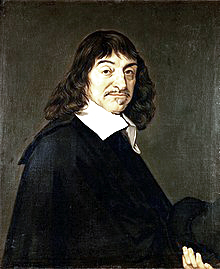
This process had been popularized by the French philosopher and mathematician René Descartes (pictured above), a leader of the Age of Enlightenment. The primary principles of the Enlightenment movement for understanding nature should be a process of reason and liberty.
The processes of the Enlightenment, however, run contrary to the principles of the Scientific Method. developed by Francis Bacon and Isaac Newton in the seventeenth century. By prioritizing empirical evidence, the goal of the Scientific Method is to eliminate personal beliefs, cultural assumptions, and wishful thinking from masquerading as facts.
Consequently, the process selected to understand inheritance, the Enlightenment, or the Scientific Method will eventually find vastly different answers.
Darwin, using the Enlightenment approach, first subscribed to the then-popular blending theory of inheritance.
Blending Inheritance 
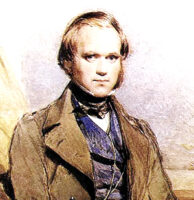
In the nineteenth century, blending inheritance had emerged as a popular theory of inheritance. Darwin (pictured right) refers to blending inheritance twenty times in The Origin of Species. However, Darwin was skeptical of “blending inheritance,” noting –
“If you cross two exceedingly close races or two slightly different individuals of the same race, then, in fact, you annul and obliterate the differences.”
Ultimately, blending inheritance homogenizes populations by blending characteristics. Therefore, new variations developed in one generation would not be preserved for inheritance in subsequent generations.
Blending inheritance eventually came to be recognized as a fatal flaw in Darwin’s theory. Darwin needed an alternative to his theory of blending inheritance.
To resolve his blending problem, Darwin reintroduced an ancient theory of inheritance, incorporating an emerging biological concept.
Pangenesis Inheritance
 Nine years following the 1859 publication of The Origin of Species, Darwin published his revised theory of inheritance. The two editions of the book, entitled The Variation of Animals and Plants Under Domestication (VAPUD), were first published in 1868 as two volumes.
Darwin introduced his new theory of inheritance, which he called pangenesis, along with his concept of gemmules. The term, Pangenesis, stems from the Greek words pan (a prefix meaning “whole”, “encompassing”) and genesis (“birth”) or genos (“origin”). However, Darwin hedged on its certain validity, noting –
“The hypothesis of Pangenesis, as applied to the several great classes of facts just discussed, no doubt is extremely complex.”
His theory extended concepts originated by the ancient Greek philosopher Hippocrates (pictured left). As Darwin notes, Hippocrates’ version was “almost identical with mine.” However, Darwin updated the theory with vague concepts from the emerging biological theory of the cell.
Pangenesis was Darwin’s blending inheritance replacement theory for the transmission of newly acquired traits from one generation to the next. Darwin coined the term “gemmules ” to describe the hypothetical, conceptual reproductive agents of life.
Darwin called his vague “small organic particles” of inheritance concept gemmules.
Gemmules are the microscopic transmitting agents that carry hereditary modifying influences resulting from the organism’s experiences.
Gemmules
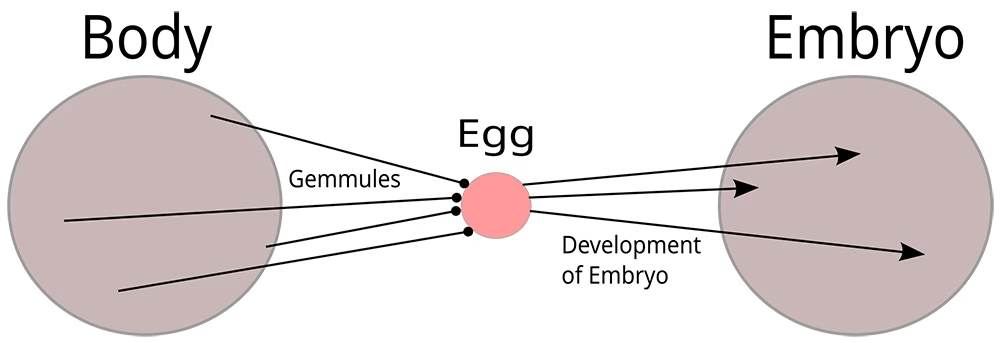 Darwin conceptualized gemmules as hypothetical “small organic particles.” Continuously released into circulation from each cell throughout the body, gemmules contain the newly acquired minute particles of inheritance.
Once released into circulation, gemmules aggregate in reproductive tissues, transferring heritable information to the gametes, to influence the characteristics of the next generation. Gemmules were the hypothetical conveyors of inheritance.
Seven years later, in 1875, Darwin published the second edition of VAPUD. The gemmules concept held the promise of a testable inheritance mechanism, development, regeneration, and the transfer of acquired variations.
In the last VAPUD edition, the terms pangenesis and gemmules appear 39 and 151 times, respectively. However, Darwin never provided a physical description—only a presumed conceptual function. Interestingly, neither term appeared in any edition of The Origin of Species.
The concept of pangenesis, however, offers a testable, less conflicted theory than blending inheritance.
Testing Pangenesis
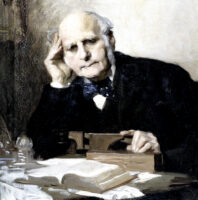
Francis Galton (pictured left), a knighted half-cousin of Darwin, designed a series of experiments to test the theory of pangenesis. Galton argued –
“Darwin’s provisional theory of Pangenesis claims our belief on the ground that it is the only theory which explains, by a single law, the numerous phenomena allied to simple reproduction, such as reversion, growth, and repair of injuries. On the other hand, its postulates are hypothetical and large, so that few naturalists seem willing to grant them.”
Using 34 white rabbits, he designed a series of blood transfusions from colored rabbits, then bred them. If pangenesis is true, some offspring should develop colored coats.
In March 1871, Galton read their test results to the Royal Society. The results were later published in the Proceedings of the Royal Society entitled “Experiments in Pangenesis, by Breeding from Rabbits.”
However, none of the rabbits showed any changes in coat color. Galton concluded that gemmules do not exist, undermining Darwin’s theory of pangenesis. In his detailed sixteen-page report, Galton stated –
“I have now made experiments of transfusion and cross circulation on a large scale in rabbits, and have arrived at definite results, negativing, in my opinion, beyond all doubt the truth of the doctrine of Pangenesis.”
However, while Darwin coined the term pangenesis, but not gemmules, the concept of pangenesis long preceded Darwin.
Pangenesis Predecessors
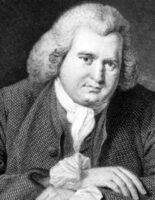 The essence of pangenesis was well known among the academic elite. Yet Darwin publicly denied any foreknowledge, even though his grandfather, Erasmus Darwin (pictured left), was one of the predecessors of pangenesis. In his widely used book, Zoonomia, he wrote –
“All animals undergo perpetual transformations, which are in part produced by their own exertions… and many of these acquired forms or propensities [acquired characteristics] are transmitted to their posterity [future generations].”
While Erasmus called inheritable “transformations” a product of “their own exertions,” these are what Darwin called gemmules. As WIKIPEDIA explains –
“In 1801, Erasmus Darwin advocated a hypothesis of pangenesis in the third edition of his book Zoonomia.“
However. While Erasmus’s evolutionary ideas gained little lasting academic influence, even with his own grandson.
Coverup
The month following the publication of VAPUD, Darwin responded to a presumed now-lost letter from William Ogle, an English physician fluent in classical Greek. In his reply, wishing he had known about pangenesis earlier, Darwin wrote –
“I thank you most sincerely for your letter, which is very interesting to me. I wish I had known of these views of Hippocrates (pictured left), before I had published, for they seem almost identical with mine—merely a change of terms—& an application of them to classes of facts necessarily unknown to this old philosopher. The whole case is a good illustration of how rarely anything is new… pangenesis has been a wonderful relief to my mind, (as it has to some few others) for during long years I could not conceive any possible explanation of inheritance.”
However, Conway Zirkle, historian of science at the University of Pennsylvania, considers Darwin’s “wish” a fabricated cover-up. In his 1935 article, “The Inheritance of Acquired Characteristics and the Provisional Hypothesis of Pangenesis,” published in the American Naturalist, Zirkle explains –
“The hypothesis of pangenesis is as old as the belief in the inheritance of acquired characters. It was endorsed by Hippocrates, Democritus, Galen, Clement of Alexandria, Lactantius, St. Isidore of Seville, Bartholomeus Anglicus, St. Albert the Great, St. Thomas of Aquinas, Peter of Crescentius, Paracelsus, Jerome Cardan, Levinus Lemnius, Venette, John Ray, Buffon, Bonnet, Maupertuis, von Haller, and Herbert Spencer.”
Without an operational theory of inheritance, the influence of Darwin’s theory increasingly waned until the late nineteenth century. However, Darwin’s inheritance problems extended beyond pangenesis.
Darwin’s Inheritance Critics
 Successfully integrating a concept of inheritance into his theory of natural selection was beyond the reach of Darwin. Each theory generated even more questions than answers.
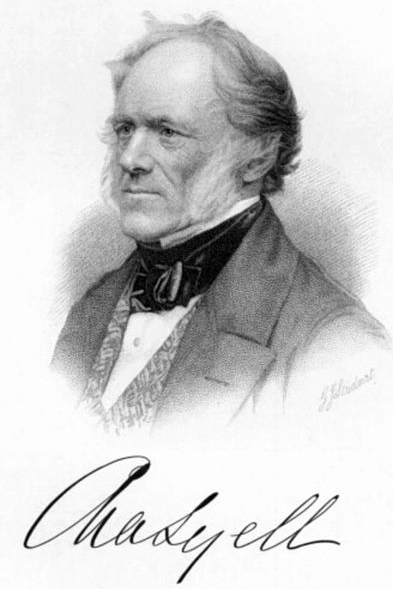
Critics also noticed that Darwin’s theory was essentially a reversion of Jean-Baptiste Lamarck’s blending inheritance theory of acquired characteristics, including Charles Lyell (pictured right), his closest colleague.
In an attempt to distance himself from Lamarck, Darwin wrote a curt letter to Lyell –
“You refer repeatedly to my view as a modification of Lamarck’s doctrine of development & progression; if this is your deliberate opinion, there is nothing to be said—but… I can see nothing else in common between the Origin & Lamarck.”
Inheritance Concessions
After seven years of work, even Darwin’s skepticism continued, given the criticisms and the seemingly “insurmountable” issues. In VAPUD’s concluding chapter, Darwin hedgingly waved a white flag –
“The hypothesis of Pangenesis, as applied to the several great classes of facts just discussed, no doubt is extremely complex; but so assuredly are the facts… The difficulty, therefore, which at first appears insurmountable, of believing in the existence of gemmules so numerous and small as they must be according to our hypothesis, has no great weight.”
However, the ultimate “difficulty” with pangenesis eventually proved that gemmules were of “no great weight.” As Darwin lamented in his Autobiography –
“My ‘Variation of Animals and Plants under Domestication [Variation Under Domestication]’ was begun, as already stated, in the beginning of 1860, but was not published until the beginning of 1868. It was a big book, and cost me four years and two months’ hard labour… In the second volume, the causes and laws of variation, inheritance, &c, are discussed as far as our present state of knowledge permits. Towards the end of the work I give my well-abused hypothesis of Pangenesis.”
Conceding to Galton’s Findings
In response to Galton’s findings, Darwin sent a letter in April 1871 to the Proceedings, noting that gemmules may have been in other bodily fluids and that he never inferred that blood contains gemmules. However, conceding to Galton’s conclusions, Darwin hedged –
“As it is, I think everyone will admit that his experiments are extremely curious and that he deserves the highest credit for his ingenuity and perseverance. But it does not appear to me that Pangenesis has, as yet, received its death blow; though from presenting so many vulnerable points, its life is always in jeopardy, and this is my excuse for having said a few words in its defense.”
Interestingly, the second edition of VAPUD preceded Darwin’s final two editions of the Origin of Species, published in 1869 and 1872. However, the terms pangenesis or gemmules never appeared even in these final editions of The Origin of Species.
Weismann’s Validation Test
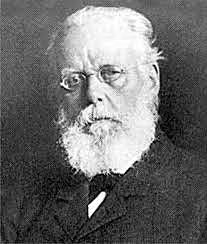 In 1892, August Weismann (pictured left), a German evolutionary biologist, challenged the viability of Darwin’s pangenesis theory. After removing the tails of 68 white mice over five generations, none of the mice developed any acquired inheritance characteristics, as Darwin predicted. The effect became known as the Weismann Barrier.
The short answer to whether scientific evidence has validated Darwin’s pangenesis theory is “none.” The Evolution 101 website, sponsored by the University of California, Berkeley, concurs –
“Darwin himself proposed that each cell in an animal’s body released tiny particles [gemmules] that streamed to the sexual organs, where they combined into eggs or sperm. They would then fuse upon mating. But “pangenesis,” as Darwin called it, didn’t hold up to scrutiny.”
However, the rediscovery of Mendel’s theory of inheritance by German geneticist Carl Correns re-ignited interest in Darwin’s theory of natural selection at the turn of the century.
Darwinism Reset
Gregor Mendel, a contemporary of Darwin, falsified the theory of blending inheritance. By studying inheritance patterns in pea plants, Gregor demonstrated that genetic traits are discrete and independent, not blended. Blending inheritance is now regarded as an “obsolete theory in biology.”
However, Darwin never acknowledged Mendel’s findings. Not until the turn of the century were Darwin’s inheritance concepts replaced by Mendel’s theory in academia. The change eventually prompted a shift from Darwinism to Neo-Darwinism.
The transition from nineteenth-century antiquated inheritance concepts to the Genomic Revolution is among the most significant in modern science. However, a scientific consensus on evolutionary inheritance mechanisms continues as unfinished business.
Genesis
 Darwin’s legacy of inheritance belongs in the halls of history, but not in science classes. The twentieth-century genomic revolution rescued Darwin’s theory of natural selection, armed with a new theory of inheritance – the modern synthesis theory.
Since then, biotechnology has shown that the modern synthesis theory fails to account for observed inheritance that appears unrelated to genetic coding.
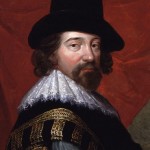
While the Genesis account written by Moses is compatible with scientific evidence, nature operates through mysteries that seemingly defy scientific explanation. As founder of the Scientific Revolution, Francis Bacon (pictured right), a pioneer of the scientific method, explains –
“God of heaven and earth had vouchsafed the grace to know the works of Creation… to discern between divine miracles, works of nature, [and] works of art.”
Inheritance, Second Principle of Natural Selection is a Theory and Consensus article.
More
Natural selection’s five principles, coined as an acronym and causal sequence, are V.I.S.T.A –
Darwin Then and Now is an educational resource on the intersection of evolution and science, highlighting the ongoing challenges to the theory of evolution.
Move On
Explore how to understand twenty-first-century concepts of evolution further using the following links –
- The Understanding Evolution category showcases how varying historical study approaches to evolution have led to varying conclusions. Subcategories include –
- Studying Evolution explains how key evolution terms and concepts have changed since the 1958 publication of The Origin of Species.
- What is Science explains Charles Darwin’s approach to science and how modern science approaches can be applied for different investigative purposes.
- Evolution and Science feature study articles on how scientific evidence influences the current understanding of evolution.
- Theory and Consensus feature articles on the historical timelines of the theory and Natural Selection.
- The Biography of Charles Darwin category showcases relevant aspects of his life.
- The Glossary defines terms used in studying the theory of biological evolution.