 Genesis, the first of the sixty-six books, is the cornerstone of the Bible; nearly every biblical author refers to it.
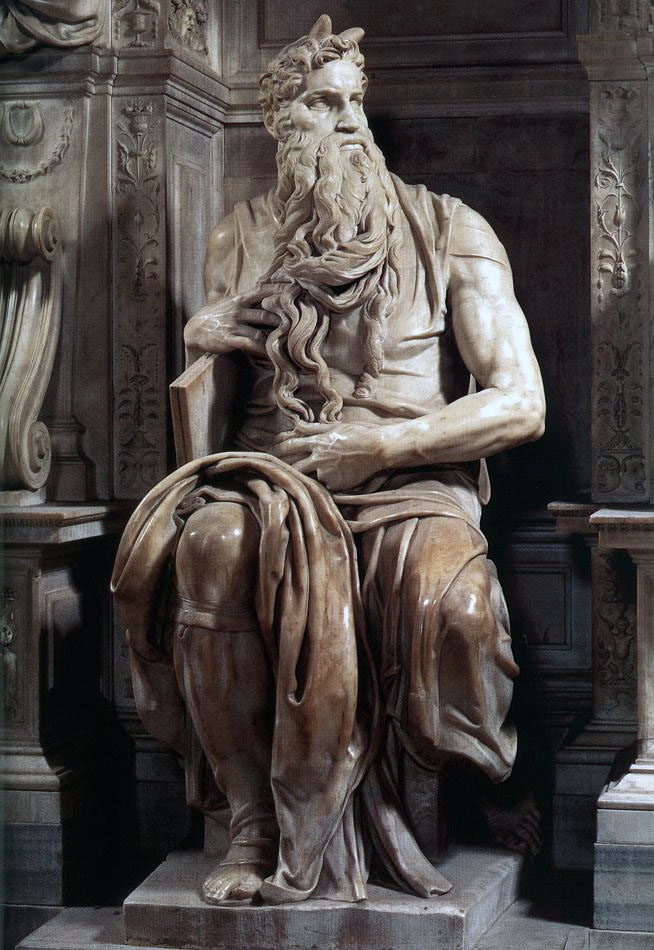
Moses (pictured right), the author, was a revolutionary. In the first five books of the Bible, Moses established the foundational pillars of an emerging Western civilization.
The Bible’s first sentence, Genesis 1:1, is one of Moses’ most recognized statements in world literature, declaring –
“In the beginning, God created the heavens and the Earth.”
 The sphere of Moses’ influence is unparalleled, extending from the origins of governance, life, the universe, to the nature of God. Yet this stunningly spectacular, infinitely complex, connected universe emerged in a moment in time, unfathomably, by the Word.
Centuries later, the elements of Moses’ literary structure played a central role in the emergence of the Scientific Revolution. Now, after more than thirty centuries of scrutiny, Moses’s account remains the most controversial, conceptually dense, yet scientific declaration in the history of the world.
Structural Elements
 The structural elements of modern scientific literature mirror those Moses introduced in his Genesis creation account. While Moses’ seven-day framework is distinctive to creation, its structural elements became the intellectual foundation of the Scientific Revolution.
Moses’ first structural element, the abstract, is followed by the introduction, methods, results, evaluation, and then the conclusion. These six elements remain the logic intellectual structure used in modern science.
Abstract
Genesis 1:1 is Moses’ abstract, the literary distillation, of the entire creation event: time, space, matter and cause. The Hebrew word selections that Moses used gives important clarity to the creation account lost, flattened, or blurred in the English translations.
Time — bǝrēʾšît (“In the beginning”) introduces the origin of time itself. It does not mean “at some early point,” but the initiation of temporal reality.
Space — hashamayim (“the heavens”) refers t the spatial expanse, the ordered structure in which physical reality exists.
Matter — ha’aretz (“the earth”) demotes the material world, the material substance of creation.
Cause — Elohim (“God”) is a masculine plural noun and bārā (created”) is a singular verb meaning to create out of nothing. Moses’ deliberate pairing signifies a majestic plurality functioning as a singular agency, a concept developed further in the Old Testament and highlighted in the New Testament.
Introduction
Moses’ introduction element in Genesis 1:2 formulates the reasoning structure for creation by defining the issue and a plan –
“The earth was without form, and void; and darkness was on the face of the deep. And the Spirit of God was hovering over the face of the waters.”
The logic began with recognizing the issues, “without form” and “darkness;” the plan was in “the Spirit of God.”
Methods, Results, and Evaluation
In Genesis 1:3–31, Moses describes the methods, results/discussions, and evaluation elements in the six consecutive days of creation.
Methods — “And God said…”
Results — “…and it was so.”
Evaluation — “Then God saw everything that He had made, and indeed it was very good.”
“Created” in Genesis 1:1 is tranlated from the Hebrew word bārā, meaning to create out of nothing. However, “created” in Genesis 1: 2 through Gensis 2:3 is translated from the Hebrew word asah, meaning to form shape or make.
Conclusion
Moses concludes the “creation” account in Genesis 2: 1–3, noting –
“Thus, the heavens and the earth, and all the host of them, were finished…. Then God blessed the seventh day and sanctified it, because in it He rested from all His work which God had created (behibbāre’ām) and made.”
Today’s modern science intellectual literature of are still built on these six structural elements introduced by Moses.
English Translations
Moses used three Hebrew words translated as “created,” and “made” in English. In Moses’ creation account in Genesis chapters 1 and 2, these three Hebrew verbs are bārā, asah, and behibbāre’ām.
bārā — בָּרָא
-
- A root word meaning to divinely create from nothing that did not exist previously – ex nihilo.
- Frequency: 6 times.
asah — עָשָׂה
-
- A root word meaning to form, shape, fashion, or make from existing elements following ex nihilo – the process.
- Frequency: 10 times.
behibbāre’ām — בְּהִבָּרְאָם
-
- A single Hebrew word formed from bārā (passive form) + asah fused together – the conclusion.
- Frequency: Once, Genesis 2:4.
Moses’ three-verb system accomplishes what is not possible in any English “God made everything” narrative. His creation narrative is framed by a scientifically comprehensive structure to account for the origin of “the heavens and the earth” from nothing.
Hebrew Literary Style
The architecture of the Hebrew literary style is distinctive characterized by the use of progressive repetition for emphasis and clarity. However, this style has sometimes been erroneously been viewed as separate creation accounts.
Contributing to this assumption is the location of chapter divisions, specifically between chapter 1 and 2. The second chapter of Genesis has, by some, erroneously been viewed as separate creation account.
However, original Hebrew writings were not divided by chapter or verse; these were added during the Middle Ages, for ease of reference purposes. However, there are several clues that chapter 2 is a continuation of chapter one.
One clue is that Moses uses the passive verb — behibbāre’ām — in Genesis 2:4 to close the creation account begun with the active verb — bārā — in Genesis 1:1. Moses wrote in Genesis 2:4 –
“This is the account of the heavens and the earth when they were created [behibbāre’ām], in the day that the LORD God made them.”
Moses summarized the completion of creation with passive reflection, rather than active creation, and indicate the shift to a terrestrial narrative. A chapter division between Genesis 2:3 and 2:4 would have textually been a more logical placement. Genesis 1:1 through Genesis 2:3 is Moses’ complete creation account.
The Bible is not a scientific textbook. howecer whenever it speaks about the natural world, its statements are scientifically valid. More importantly, the Genesis account of creation is the Bible’s ontological foundation: it establishes that divine authority precedes, defines, and governs reality itself.
Books Linked to Genesis
While nearly every biblical writer refers back to Genesis directly or indirectly, twenty-five books explicitly draw on Moses’ creation account.
Genesis is the cornerstone book of the Bible; the key foundational book of the biblical narrative.

Darwin Then and Now is an educational resource on the intersection of evolution and science, highlighting the ongoing challenges to the theory of evolution.
Explore how to understand twenty-first-century concepts of evolution further using the following links –
-
- The Understanding Evolution category showcases how varying historical study approaches to evolution have led to varying conclusions. Subcategories include –
- Studying Evolution explains how key evolution terms and concepts have changed since the 1958 publication of The Origin of Species.
- What is Science explains Charles Darwin’s approach to science and how modern science approaches can be applied for different investigative purposes.
- Evolution and Science feature study articles on how scientific evidence influences the current understanding of evolution.
- Theory and Consensus feature articles on the historical timelines of the theory and Natural Selection.
- The Biography of Charles Darwin category showcases relevant aspects of his life.
- The Glossary defines terms used in studying the theory of biological evolution.
- The Understanding Evolution category showcases how varying historical study approaches to evolution have led to varying conclusions. Subcategories include –