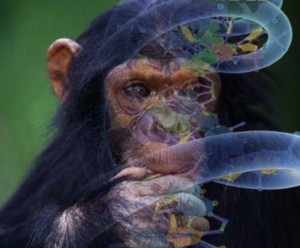
 The name “chimpanze” was first published in The London Magazine in 1738, meaning “mockman” in Angola. While the “chimpanzee” spelling appeared in a 1758 supplement to Chambers’ Cyclopædia, the “chimp” colloquialism was coined in the 1870’s.
Before the publication of The Origin of Species in 1859, Charles Darwin gave his view of the differences between chimpanzees and humans. In a letter sent to Joseph Hooker, a close colleague, it read –
“I cannot swallow Man [being that] distinct from a Chimpanzee.”
The Descent of Man
In the six editions of The Origin of Species, Darwin never mentions chimpanzees. However, by the 1874 edition of The Descent of Man, the term “chimpanzee” appears thirty-seven times. In The Descent of Man, Darwin argued –
“It is therefore probable that Africa was formerly inhabited by extinct apes closely allied to the gorilla and chimpanzee; and as these two species are now man’s nearest allies”
While Darwin never stated that humans were direct descendants of chimpanzees, the concept remained widely popular.
Modern Evolution Science
By the late twentieth century, advances in molecular biology had begun to clarify the distinct similarities between humans and chimpanzees. Surprisingly, genetic evidence demonstrated that human and chimpanzee DNA differ by only about 1% in protein‑coding regions.
Early genetic findings reinforced the classification of chimpanzees as Great Apes, in the family Hominidae, which also includes humans. By the late twentieth century, molecular scientists increasingly clarified the perceived morphological and behavioral similarities between chimpanzees and humans.
However, these discoveries also fueled widespread public misconceptions. Journalists and even some scientists equated these similarities, blurring the distinction between “closest living relative [kind]” and “ancestor.” Logically, modern chimpanzees seemed to be in the direct line of human descent.
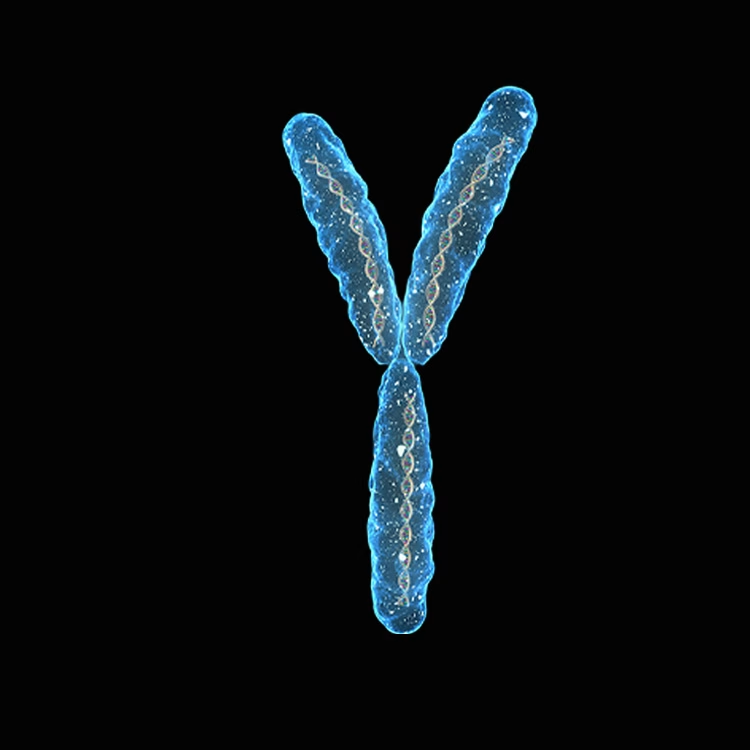 Since the late twentieth century, increasingly sophisticated genetic technologies have objectively tested genetic evidence. Whole‑genome sequencing and high‑resolution Y‑chromosome (pictured right) analyses have revolutionized the testing of logical direct line descent concepts.
X and Y Chromosomes
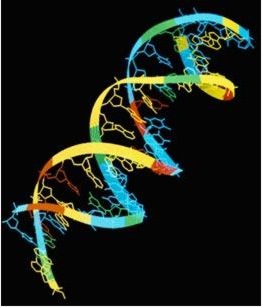
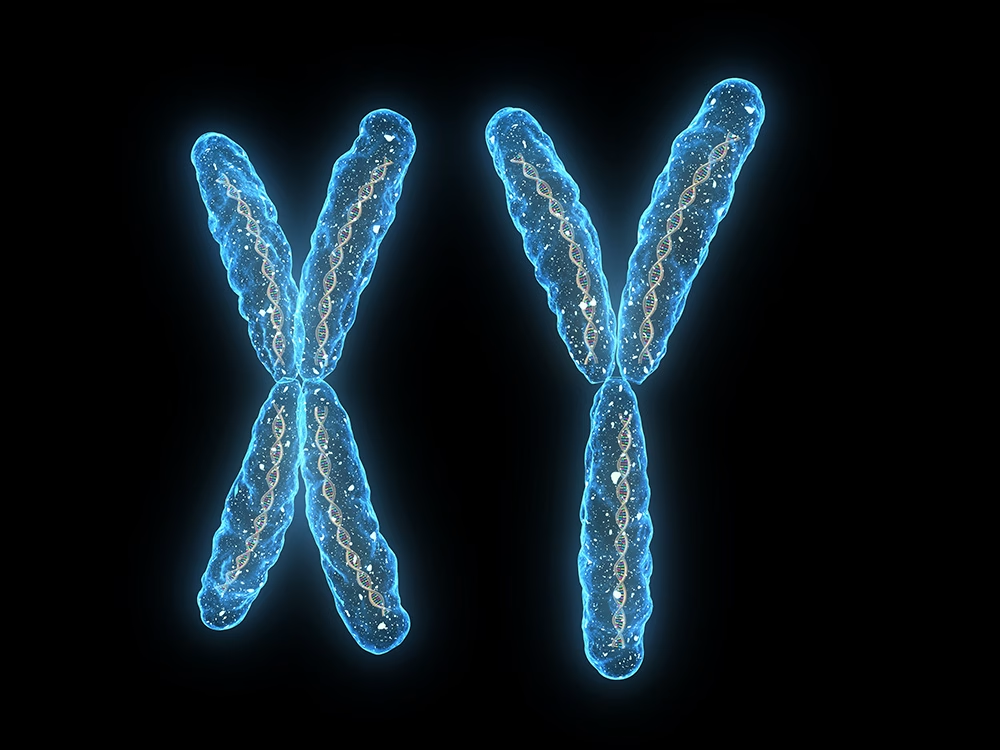 DNA nucleotides take the shape of an X or Y (pictured left) only during cell division. Each nucleotide consists of a phosphate group, a deoxyribose sugar, and a nitrogenous base (A, T, C, or G). When joined together, they form a DNA double helix (pictured right), which looks like a twisted ladder.
Chromosomes take on an X‑shaped appearance only during metaphase of cell division, when they are tightly condensed and duplicated.
- Most chromosomes look like an X because they consist of two identical sister chromatids joined at a centromere.
- The Y chromosome is called “Y” because it is smaller and has a shape that resembles a Y under the microscope — but this is a visual convention, not a molecular shape.
Y Chromosome Distinctives
The Y chromosome is uniquely powered for reconstructing paternal lineages and estimating potential divergence times between species, specifically –
-
- No recombination. The Y passes almost unchanged from father to son. Mutations accumulate in a clean, linear fashion, making the Y ideal for building phylogenetic trees and molecular clocks.
- Small effective population size. Because only males carry it, the Y is more sensitive to bottlenecks, founder effects, and male‑biased migrations.
- High mutation rate in some regions. This increases resolution for recent adaptive events.
- Deep conservation of certain genes. Some Y‑linked genes (e.g., SRY) are conserved across mammals, allowing comparisons across large descent distances.
Until the twentieth-century revolution in genomics, chimpanzees remained genetically untestable as human ancestors.
Chimp and Human Y Chromosome Evidence
The January 2010 paper published in the British journal Nature upended presumptions about any ancestral link between chimpanzees and humans. The paper, “Chimpanzee and Human Y Chromosomes are Remarkably Divergent in Structure and Gene Content,” reported that Y chromosomes in the chimp and humans “differ radically in sequence structure and gene content.” In total –
“More than 30% of the chimp Y chromosome lacks an alignable counterpart to the human Y chromosome.”
 Jennifer F. Hughes (pictured right), at the Whitehead Institute for Biomedical Research in Cambridge, Massachusetts, a leading genomic research center, concluded –
“By comparing the MSYs [male‑specific region} of the two species, we show that they differ radically in sequence structure and gene content.”
The MSY region preserves a clear biological record of paternal history. Therefore, the difference between chimpanzees’ and humans’ MSY region is evidence that humans are not ancestrally related to chimpanzees. ScienceDaily noted –
“By conducting the first comprehensive interspecies comparison of Y chromosomes, Whitehead Institute researchers have found considerable differences in the genetic sequences of the human and chimpanzee Ys… The results overturned the expectation that the chimp and human Y chromosomes would be highly similar. Instead, they differ remarkably in their structure and gene content.”
The original chimp genome sequencing completed in 2005 largely excluded the Y chromosome because its hundreds of repetitive sections had typically confounded standard sequencing techniques. The chimp Y chromosome is only the second Y chromosome to be comprehensively sequenced.
 Wes Warren (pictured left), Assistant Director of the Washington University Genome Center, noted –
“These findings demonstrate that our knowledge of the Y chromosome is still advancing.”
Earlier comparative studies between the chimp and human genomes had centered on DNA regions that encode only proteins. In addition, the chimp’s DNA is 12% larger than human DNA.
The research was funded by the National Institutes of Health (NIH) and the Howard Hughes Medical Institute (HHMI).
Implications
Evolution scientists had long anticipated that chimp genetics would align with human genetics. Darwin had written –
“By the theory of natural selection, all living species have been connected with the parent-species of each genus… So that the number of intermediate and transitional links, between all living and extinct species, must have been inconceivably great. But assuredly, if this theory be true, such have lived upon the Earth.”
The genomic revolution, however, has since falsified that theory – intensifying Darwin’s dilemma.
Genesis
Long-standing assumed examples of biological evolution are increasingly challenged by scientific investigations using advanced biotechnologies. Scientific evidence always aligns with the Genesis account written by Moses.
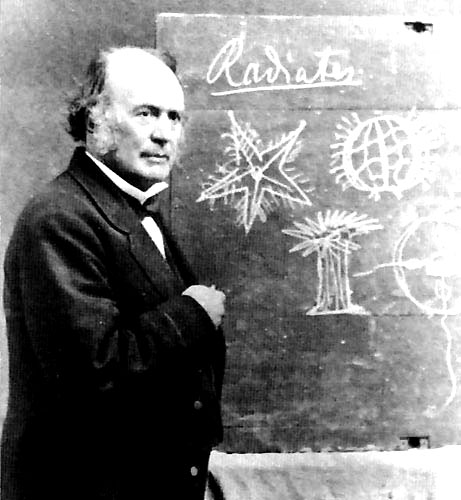 Jean Agassiz, a Swiss-American biologist and geologist, a Wollaston Medal winner (1836), concluded –
“Every scientific truth goes through three states: first, people say it conflicts with the Bible; next, they say it has been discovered before; lastly, they say they always believed it.”
Evidence using advanced biotechnologies underscores why the theory of evolution is increasingly recognized as a theory in crisis.
Chimpanzee and Human Y Chromosomes is a Molecular Biology article.
Darwin Then and Now is an educational resource on the intersection of evolution and science, highlighting the ongoing challenges to the theory of evolution.
Move On
Explore how to understand twenty-first-century concepts of evolution further using the following links –
-
- The Understanding Evolution category showcases how varying historical study approaches to evolution have led to varying conclusions. Subcategories include –
- Studying Evolution explains how key evolution terms and concepts have changed since the 1958 publication of The Origin of Species.
- What is Science explains Charles Darwin’s approach to science and how modern science approaches can be applied for different investigative purposes.
- Evolution and Science feature study articles on how scientific evidence influences the current understanding of evolution.
- Theory and Consensus feature articles on the historical timelines of the theory and Natural Selection.
- The Biography of Charles Darwin category showcases relevant aspects of his life.
- The Glossary defines terms used in studying the theory of biological evolution.
- The Understanding Evolution category showcases how varying historical study approaches to evolution have led to varying conclusions. Subcategories include –