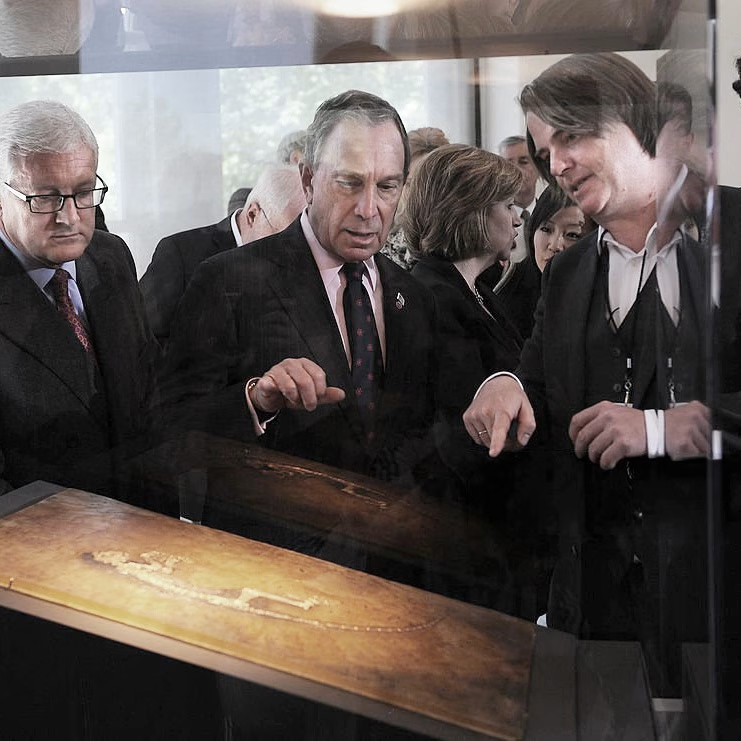
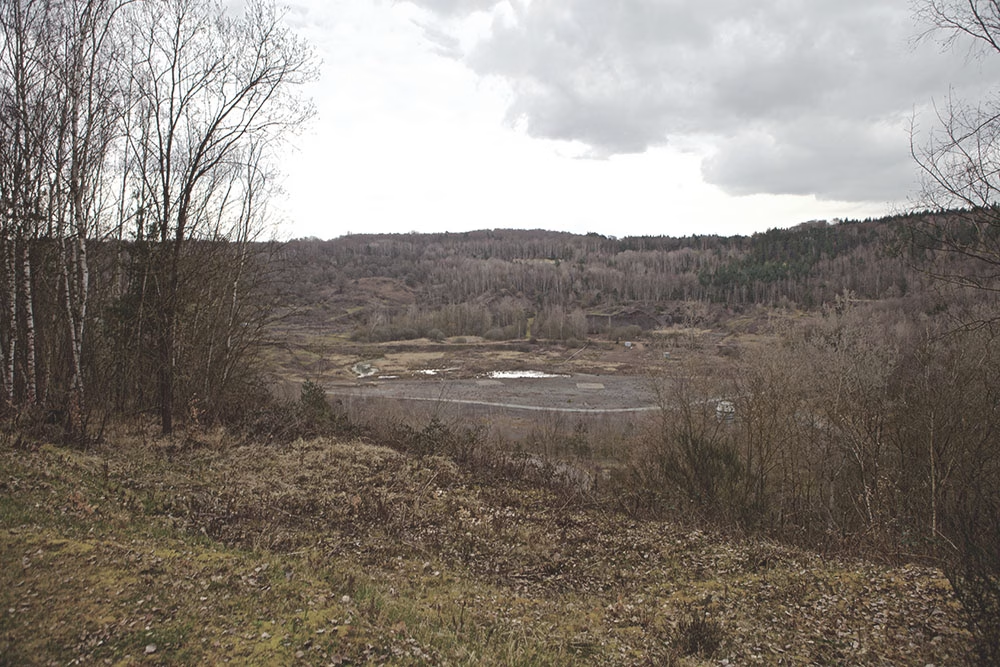
 The discovery of a primate-like fossil named Ida in 1983 launched a complex, nearly three-decade-long investigative and media blitz and bust. Ida (pictured left with Bloomberg and Hurum) was discovered in the Messel quarry (pictured right) in Hesse, Germany.
Rumors soon emerged that this pristine, primate-like fossil appeared to be a potential link in human evolution. In 1995, the pit was declared a UNESCO World Heritage Site. By 2009, Jens Lorenz Franzen (pictured right below with Ida and Hurum), head of Paleoanthropology at the Naturmuseum Senckenberg in Frankfurt, declared the fossil as –
“The eighth wonder of the world.”
Ida’s Journey
 Between 1983 and 2007, however, the fossil journeyed through the secretive world of private fossil trading. Originally, the fossil evidence was split between its two slate slabs by an unknown collector.
The biological evidence was essentially all in the A-plate (main slab), while its impression was mirrored in the B-plate. Superficially, the creature resembled a modern lemur.
At the time, the two slabs were sold separately to anonymous private collectors. Their whereabouts remained a mystery until the Hamburg Fossil & Mineral Fair in December 2006.
In 2007, Norwegian paleontologist Jørn H. Hurum of the University of Oslo acquired the A‑plate for a rumored $750,000. For the transition, Hurum collaborated with Franzen in Germany.
Ida Renamed
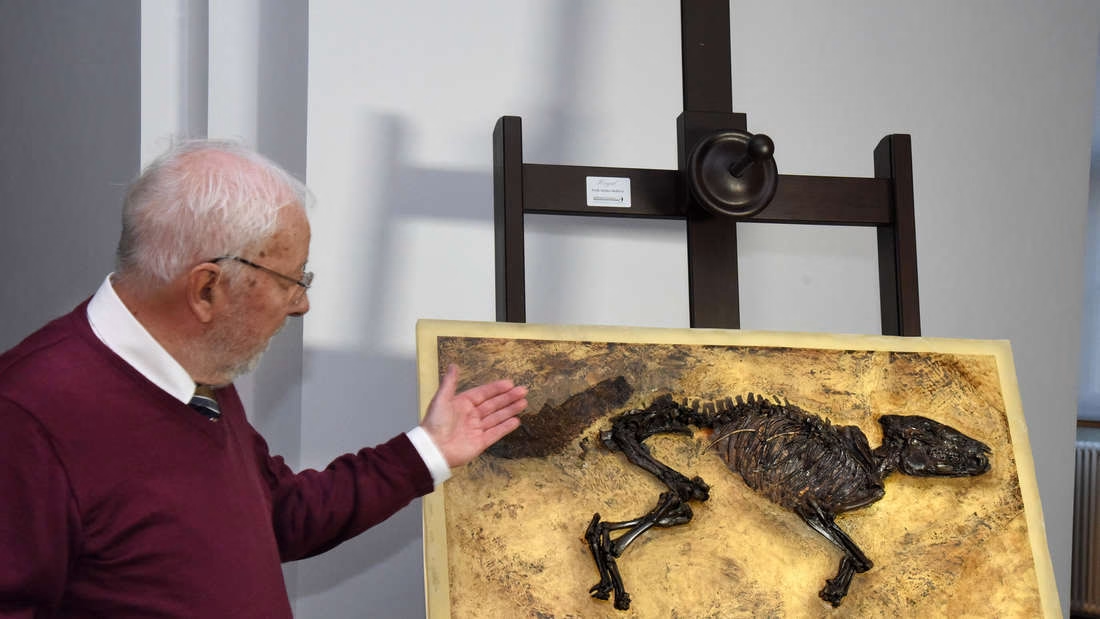 In recognition of Charles Darwin’s upcoming birthday and the 150th anniversary of The Origin of Species, Ida (pictured left with Franzen) was renamed Darwinius masillae. The species-specific epithet masillae recognizes the geological location of its finding — Messel.
Since the near-complete skeleton had spent decades in private hands, it underwent several inspections that confirmed it was not a professional counterfeit. It passed all tests.
Recognizing that the fossil did not fit any existing genus within Adapidae, Franzen taxonomically placed Darwinius as a new Genus. The Adapidae family includes extinct primates; however, the systematic and evolutionary relationships of Adapidae are still only inferred.
Study Findings
Franzen directed the team studying the Darwinius masillae fossil using X-radiography, laser scanning, and CT images. Observations were measured with calipers, aided by a binocular microscope or a hand lens.
The findings were compared to a range of similar images and specimens. These included other Messel primates, Eocene primate specimens, and previously published radiographs and skeletal images.
Biological elements measured and studied the skeleton, soft‑tissue outlines, stomach contents, fur shadowing, and limb proportions. Importantly, however, the team’s findings were not compared with those from Homo species, nor were biomolecular comparisons studied.
Report Released
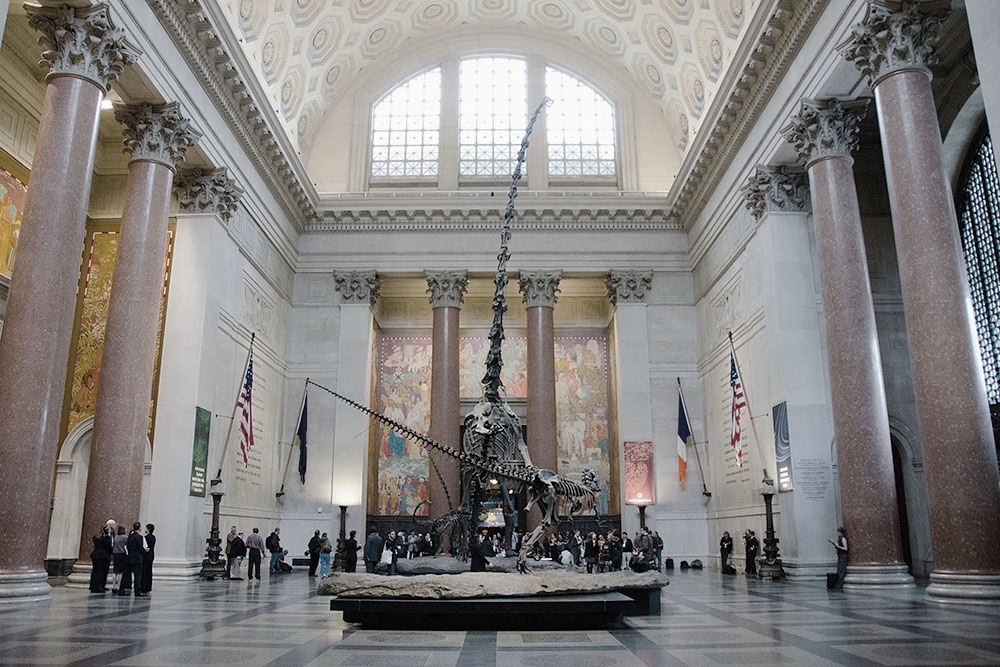 The first peer-reviewed report on Ida was published on May 19, 2009, with Franzen as the primary author. The report was published in the journal PLOS ONE entitled the “Complete Primate Skeleton from the Middle Eocene of Messel in Germany.”
On the same day, the American Museum of Natural History (AMNH – pictured left)) hosted a high-profile press conference to announce the paper. Hurum (pictured right), the public presenter, spoke from “The Link” podium and declared –
“This fossil rewrites our understanding of the evolution of primates… It will probably be pictured in all the textbooks for the next 100 years.”
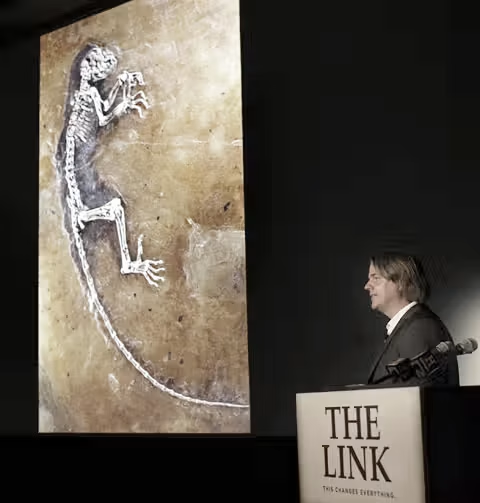 Importantly, neither Franzen nor Hurum claimed that the fossil was a transitional link to humans, a “missing link” in human evolution, or a human ancestor. However, Hurum and conference contexts issued suggestive inferences, including “The Link” podium poster and stating –
“It tells a part of our evolution that’s been hidden so far. It’s been hidden because the only [other] specimens are so incomplete and so broken there’s almost nothing to study.”
The paper’s release was a highly orchestrated media event, the most orchestrated paleontology media event ever staged. However, the media’s coverage took the inferences as scientific facts.
Media Blitz
 The media blitz on Ida was on par with a worldwide scientific announcement. Along with the journal release and press conference, the Ida media package included a documentary film, book, press kits, and interviews.
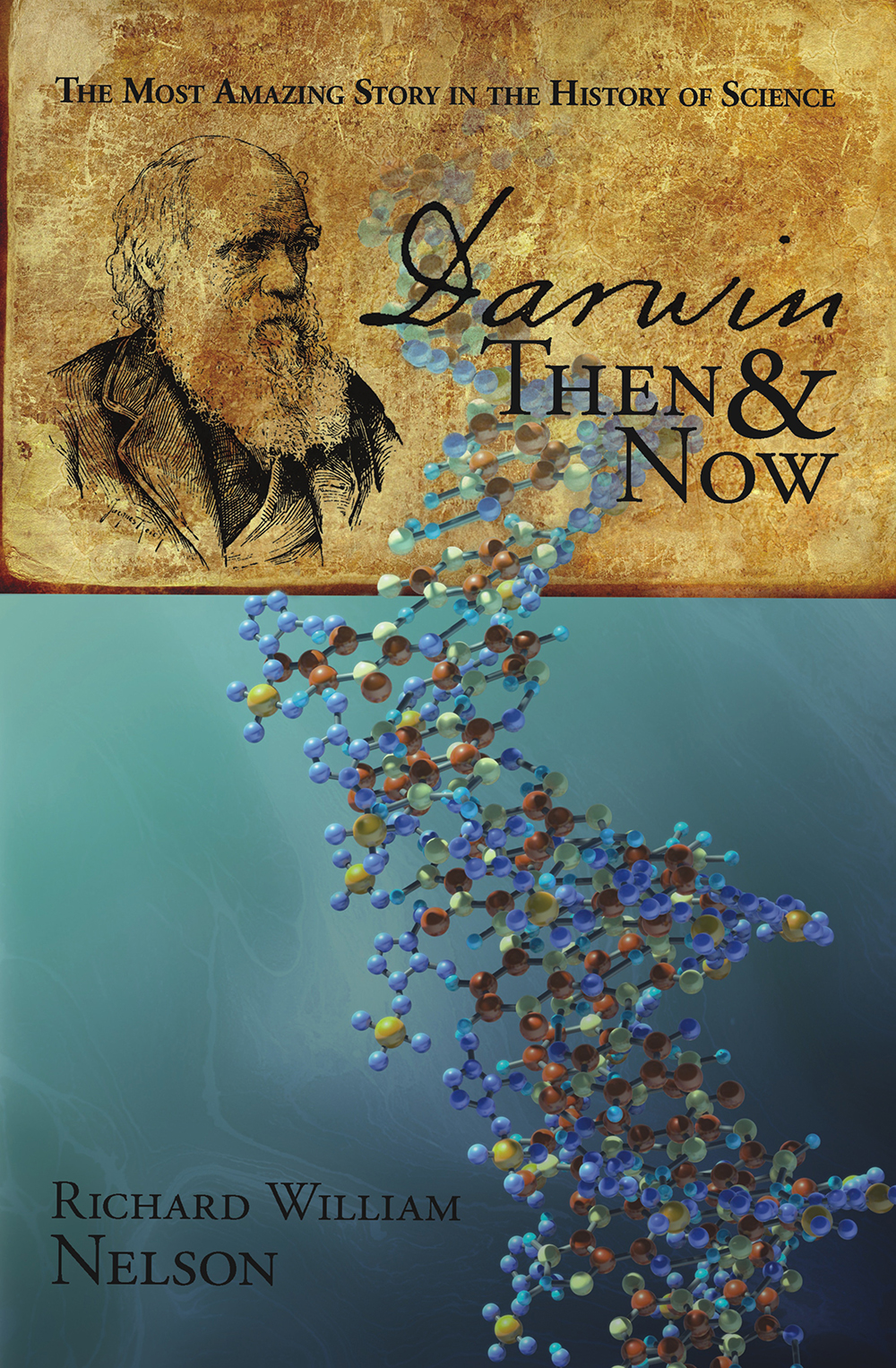
The Guardian, BBC, New York Times, Associated Press, and National Geographic published synchronized coverage on the same day. The BBC documentary film and book, Uncovering Our Earliest Ancestor: The Link (pictured left), narrated by David Attenborough, was aired on the BBC and the History Channel.
The Guardian reported Ida “could be the root of the human lineage,” while the Associated Press wrote, “may be a direct link to humans.” The BBC described Ida as “the missing link” and “a direct ancestor of humans.” National Geographic echoed similar claims.
 “This little creature is going to show us our connection with the rest of all the mammals,” said David Attenborough (pictured right with Charles III). Attenborough had narrated a BBC documentary that aired on the same day, declaring –
“The more you look at Ida, the more you can see, as it were, the primate in embryo.”
Associated Press said Ida “may be a direct link to humans,” while the New York Times repeated the “link” narrative. In the BBC film documentary “Uncovering Our Earliest Ancestor: The Link” aired the same day, Attenborough stated —
“This little creature is going to show us our connection with the rest of all the mammals.”
Media Bust
 Within 24–48 hours of the media blitz, experts in primate evolution explained why the media’s presentations were scientifically unsupportable. While agreeing that Ida was a beautiful adapid, primate experts did not agree that it was a human ancestor.
Five months later, the BBC published a corrective article in October titled Primate Fossil ‘Not an Ancestor.’ The BBC explicitly stated –
“The exceptionally well-preserved fossil primate known as “Ida” is not a missing link as some have claimed.”
Blythe Williams, professor of Evolutionary Anthropology at Duke University, agreed. In Darwinius masillae is a Strepsirrhine (March,2010) published in the Journal of Human Evolution, Williams concurred –
“Franzen et al. (2009) make a strong case that Darwinius is an adapiform, but none of the characters they invoke provide support for the hypothesis that Darwinius (or any other adapiforms) are stem haplorhines.”
Ida remains scientifically important — but not for the reasons promoted on May 19, 2009, further crystallizing Darwin’s dilemma. According to Darwin –
“If it could be demonstrated that any complex organ existed, which could not possibly have been formed by numerous, successive, slight modifications, my theory would absolutely break down.”
Ida highlights why evolution remains a theory in crisis.
Genesis
 The fossil record is compatible with the Genesis account written by Moses. Jean Louis Rodolphe Agassiz, a Swiss-American biologist and geologist credited for developing the Ice Age concept, explains how ideas sometimes advance during the Scientific Revolution –
“Every scientific truth goes through three stages: first, people say it conflicts with the Bible; next, they say it has been discovered before; lastly, they say they always believed it.”
Science evaluates natural causes and effects. Creation, understood as a supernatural act, does not operate through natural mechanisms and therefore lies beyond the reach of scientific validation or invalidation. The Genesis account of creation is supernatural in character, like other biblical events, and is not subject to empirical testing.
Life and the universe, however, are a reality, not abstract concepts.
Ida Fossil, Media Blitz and Bust is a Fossil Record article.

Darwin Then and Now is an educational resource on the intersection of evolution and science, highlighting the ongoing challenges to the theory of evolution.
Move On
Explore how to understand twenty-first-century concepts of evolution further using the following links –
-
- The Understanding Evolution category showcases how varying historical study approaches to evolution have led to varying conclusions. Subcategories include –
- Studying Evolution explains how key evolution terms and concepts have changed since the 1958 publication of The Origin of Species.
- What is Science explains Charles Darwin’s approach to science and how modern science approaches can be applied for different investigative purposes.
- Evolution and Science feature study articles on how scientific evidence influences the current understanding of evolution.
- Theory and Consensus feature articles on the historical timelines of the theory and Natural Selection.
- The Biography of Charles Darwin category showcases relevant aspects of his life.
- The Glossary defines terms used in studying the theory of biological evolution.
- The Understanding Evolution category showcases how varying historical study approaches to evolution have led to varying conclusions. Subcategories include –