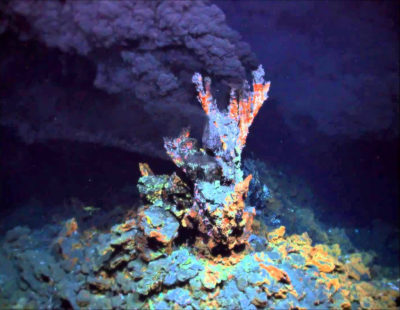
 Modern formulations of the hydrothermal‑vent origin‑of‑life concepts began in 1989 with a publication by British geologist Michael Russell. The publication “In vitro growth of iron sulfide chimneys: possible culture chambers for origin-of-life experiments” seemingly cracked an evolution mystery.
Published in Terra Nova, Russell outlines a pathway that naturally progresses from chemistry to biology – the origin of life. Russell’s concept was groundbreaking. In essence, Russell envisioned –
“Life is what happens when Earth’s geochemistry progresses into organized chemistry.”
Hydrothermal vents are geological formations on the ocean floor, typically along mid-ocean ridges, where seawater seeps into the Earth’s crust.
Twentieth Century
Chemistry
The composition of Earth’s chemicals is understood as the source of all essential elements for the formation of life. However, life is more than an assortment of chemicals – it consists of reproductively integrated aqueous energy-producing systems.
Geological formation types, specifically hydrothermal vents, were considered as a possibility for forming life’s first cell-like structure. Vents are aqueous, chemically rich, including iron sulfide, and structured by the energy of Earth’s forces.
 Russell (pictured right), working with geologist Allan Hall, published a concept linking the origin of life to energy in 1994. The concept, in essence, hypothesized –
“Life is what happens when Earth’s geochemical energy finds a way to flow through organized chemistry.”
Their paper was published in the Journal of the Geological Society entitled “The emergence of life from iron monosulphide bubbles at a submarine hydrothermal redox and pH front.” Their concept laid the foundations for what would become known as the Chemiosmosis Origin‑of‑Life hypothesis, or simply Chemiosmosis.
Chemiosmosis
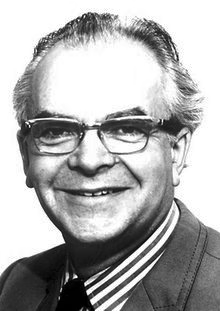 Previously, in the 1960’s, Peter D. Mitchell (pictured left) developed the chemiosmotic concept – biology’s energy-conversion mechanism. In his paper published in the journal Nature, he proposed that electrochemical gradients across membranes produce life’s energy currency.
At the time, adenosine triphosphate (ATP) was known to be life’s prime energy carrier. But the mechanism by which mitochondria produced and stored this energy remained unresolved.
To clarify the biological basis of energy transduction, Mitchell analyzed how chemical concentrations and ion charges differ across membranes. The combined difference between these two forces — the chemical and electrical gradients — became known as the electrochemical gradient. The stored energy that powers ATP synthesis.
This gradient formed the empirical foundation for Mitchell’s chemiosmotic concept. Electrochemical gradients — later termed the proton‑motive force — drive ATP synthesis by powering the rotary mechanism of ATP synthase.
In recognition of this discovery, Mitchell was awarded the 1978 Nobel Prize in Chemistry. But Mitchell had not envisioned the concept playing a role in solving the evolutionary origin-of-life mystery.
However, Russell and Hall did, and Mitchell’s concept has continued into the twenty-first century.
Twenty-First Century
 Origin-of-life researchers Nick Lane (pictured right) and William F. Martin just published the paper “The Origin of Membrane Biogenetics” in last month’s issue of the journal Cell. They concur with Mitchell, Russel, and Hall that –
“Dependence on membrane bioenergetics is as universal as the genetic code.”
More specifically, they concluded that proton gradients in alkaline hydrothermal vents could have supported abiogenesis, noting in their paper –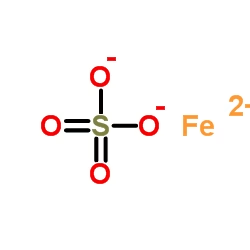
“Natural proton gradients acting across thin FeS (Ferrous Sulfate, pictured left) walls within alkaline hydrothermal vents could drive carbon assimilation, leading to the emergence of protocells within vent pores.”
Lane and Martin’s paper was widely cited in the media. Interest in the study reflected continued interest in the hydrothermal vent origin-of-life model, second only to the RNA World model.
The hydrothermal vent origin-of-life model is also known, more broadly, as the bioenergetic origin-of-life concept. Non-oceanic vents include nuclear geyser systems, volcanic hot springs, and diverse types of aquatic hydrothermal fields.
Media Highlights
 The journal Nature featured Lane’s and Martin’s paper in an article entitled “How Life Emerged from Deep-Sea Rocks” by science writer Ed Yong (pictured right). Yong subtitled the article –
“The origin of ion-pumping proteins could explain how life began and escaped from undersea thermal vents.”
Yong highlighted Lane’s and Martin’s argument as the decisive innovation that allowed early cells to seal their membranes and escape the vent environment.
 NBC NEWS science writer, Tia Ghose (pictured left), in the featured article titled “Theorists are pumped up about their new origin of life proposal” reported –
“A new theory proposes the primordial life-forms that gave rise to all life on Earth left deep-sea vents because of their ‘invention’ of a tiny pump. These primitive cellular pumps would have powered life-giving chemical reactions.”
In general, media coverage in Quanta Magazine and Smithsonian Magazine portrayed their work as a major, paradigm‑shifting alternative to traditional origin‑of‑life models. Viviane Callier (pictured right), writing for The Smithsonian, noted –
“Among biologists, few questions have been debated as fiercely as the origin of life… One possibility for the origin of life is that, over time, these relatively simple geochemical reactions evolved into the reactions that create the building blocks of life.”
However, Lane’s and Martin’s hydrothermal‑vent concept has science critics.
Hydrothermal‑Vent Origin-of-Life Critics
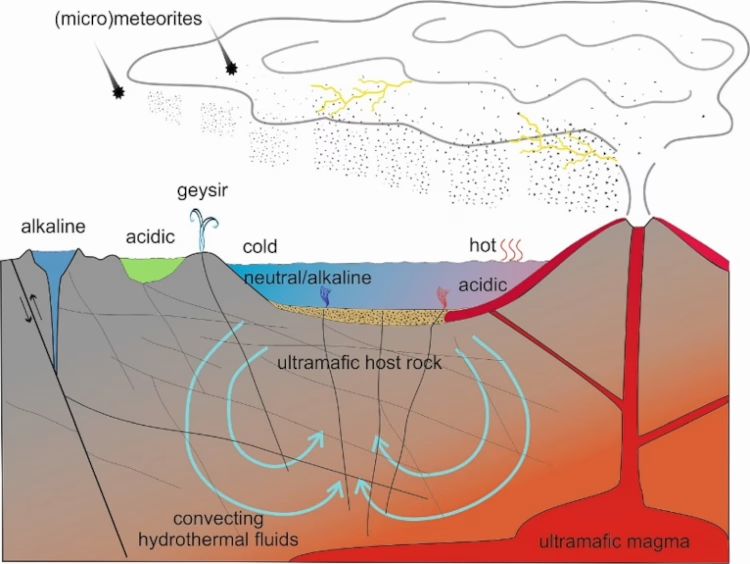 The hydrothermal‑vent origin-of-life concept drew sharp criticism from both geochemists and evolutionary biochemists who questioned its scientific validity.
Wolfgang Nitschke, of the French National Centre for Scientific Research, in an interview with the journal Nature, noted about hydrothermal‑vent –
“[It is] in stark contrast to basically all other origin-of-life hypotheses.”
Stuart A. Newman, professor at the New York Medical College, views the origin of life as a self-organization process. Rather, the origin of life develops through “dynamical patterning modules.”
Stuart Kauffman, of the University of Vermont, views the origin of life as a matter of self-organization through “genetic regulatory networks” – independent of hydrothermal vents.
 Alan C. Love (pictured right) of the University of Minnesota, a participant in the Altenberg Summit in 2008, lamenting the state of the evolution industry, concluded –
“My account also meshes with the recognition that a fully unified view of evolutionary processes may be out of reach.”
Importantly, however, scientific organizations have yet to develop a scientific consensus on any natural mechanism for the origin of life. A comprehensive scientific explanation for the origin of life is essential for a comprehensive theory of the emergence of Earth’s biosphere.
Conflicted Charles Darwin
Charles Darwin was conf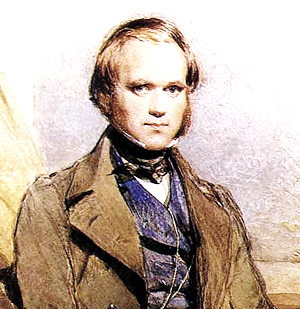 licted over an explanation for the origin of life. In the letter to J.D. Hooker in March 1863, Darwin privately expressed his disdain for even addressing the topic, declaring —
“It is mere rubbish thinking at present of the origin of life.”
However, since natural selection acts only on what exists, Darwin logically also needed an explanation for the origin of life. In the last sentence of his 1st edition in 1859, Charles Darwin alluded to an effect, writing –
‘There is grandeur in this view of life, with its several powers, having been originally breathed into a few forms or into one…”
In science, however, an effect requires a material cause. In his 2nd Edition, published just months later in 1860, he updated the sentence to –
“There is grandeur in this view of life, with its several powers, having been originally breathed by the Creator into a few forms or into one.”
All the remaining editions used this same last sentence. Darwin had been in a logical dilemma since natural selection only acts on what already exists. In his final 6th Edition, “Creator” is used nine times.
Genesis
The Genesis account, written by Moses, was foundational to the scientific revolution. According to William Thomson, 1st Baron Kelvin, an Irish mathematical physicist and engineer who formulated the first and second laws of thermodynamics –
“Mathematics and dynamics fail us when we contemplate the Earth, fitted for life but lifeless, and try to imagine the commencement of life upon it… We must pause, face to face with the mystery and miracle of creation of living creatures.”
Evidence from origin-of-life research underscores why the theory of evolution from molecules to man has yet to be scientifically validated.
2026 Update
The two most popular natural explanations for the emergence of life on Earth still begin from one of two places –
Darwin’s “warm little pond,” or
Ocean floor hydrothermal vents
Since posting Origin-of-Life, Hydrothermal-Vents in 2013, technical advances have broadened our understanding of plausible physical links and the origin of life.
The modern “warm little pond” model has primarily developed into the RNA-World origin-of-life hypothesis. While neither model provides empirical evidence of life’s emergence, the RNA-World hypothesis is the least problematic.
These two most popular models emerged from two different perspectives, both essential. Bioenergy is the foundation of the hydrothermal vent hypothesis; genetic inheritance is the foundation of the RNA World hypothesis. Energy-first vs. genetics-first. One begins with thermodynamics, the other with information theory.
Hydrothermal-Vents Origin of Life Hypothesis
 In 2026, Carly Cassella (pictured right), senior journalist at Science Alert, summarized the most serious criticisms of the hydrothermal‑vent origin-of-life concepts as follows –
-
- No strong proton gradients develop at hydrothermal temperatures
- Ancient oceans and vents lacked sulfur → no FeS membranes
- Vent systems were geologically too shallow and short‑lived
- Complex organics cannot form efficiently in serpentinite systems, which tends to erase or alter complex organics
- No evidence for thin mineral membranes capable of sustaining energy gradients
- Gradient‑driven proto‑motors are mechanistically implausible
A few academic institutions have focused on hydrothermal‑vent origin‑of‑life hypotheses. These include Rutgers University, the University of Cambridge, and the University of Western Australia.
Researchers at these institutions have published work advancing the concept that hydrothermal vents are plausible cradles for early life. More recently, however, they have not been actively publishing new reports.
RNA‑World Origin‑of‑Life Hypothesis
The academic institutions most directly focused on RNA World origin-of-life hypotheses. These include the Salk Institute, the Scripps Research Institute, and the Cold Spring Harbor Laboratory. And, more recently, they have not been actively publishing new RNA World reports.
Currently, no university has a department focused on solving the origin-of-life mystery. Programs, yes; departments, no.
Origins Federation
The Origins Federation, formed in 2023 by Harvard University, is a consortium of four origin‑of‑life research programs, including –
Yale University and Massachusetts Institute of Technology (MIT) are not members of the Origins Federation even though they have strong historical and scientific ties to origin‑of‑life research.
Current Progress
A natural explanation of the origin-of-life is the foundation of a comprehensive evolutionary hypothesis of Earth’s biosphere. Recent major scientific advances include –
-
-
- Self‑sustaining proto‑metabolic networks (2026)
- RNA polymerization in volcanic glass (2022)
- Prebiotic phosphorylation pathways (2025–2026)
- Meteorite‑derived vesicle formation (2024–2026)
- Ribozymes capable of copying functional RNA (2024–2025)
-
However, despite these advances, none of these have been empirically observed to be a causative factor in any origin‑of‑life event.
Hydrothermal Vents is an Origin of Life article.

Darwin Then and Now is an educational resource on the intersection of evolution and science, highlighting the ongoing challenges to the theory of evolution.
Explore how to understand twenty-first-century concepts of evolution further using the following links –
-
- Understanding Evolution is a journey that showcases how different investigative approaches play a pivotal role in enriching our understanding of the process, leading to diverse conclusions.
- Studying Evolution defines the terms “species” and “natural selection” and how they have changed since The Origin of Species was published in 1859.
- What is Science investigates Charles Darwin’s approach to science and how the principles of modern science are used for different investigative purposes.
- The Evolution and Science category features articles studying how the intersection of evolution and science influences the current understanding of evolution.
- The Theory and Consensus category features articles examining how scientific findings are influencing the scientific consensus on the essential tenets of evolution, including Natural Selection.
- Glossary defines terms associated with explaining the theory of biological evolution.