by Richard William Nelson | Mar 31, 2017
 The behavioral evolution in the red fire ant species, which has two distinct types of colonies —one with a single queen and one with multiple queens —has long puzzled biologists. An invisible border seems to exist between the two. The male ants quickly destroy the Queen ants that happen to wander between colonies. To understand what evolutionary mechanisms might be at play, molecular scientists have recently turned to the genome.
At Queen Mary University of London, a team of biochemists led by Rodrigo Pracana (pictured below) sequenced the whole genome in both colony types to examine the genetic difference between the two types of colonies – SB and Sb. Surprisingly, rather than finding “slight, successive changes” as predicted by Charles Darwin’s theory of evolution, they discovered the two genes to be “highly divergent” from each other.
Continue Reading
by Richard William Nelson | Nov 4, 2014
The European eel illustrates exactly why Charles Darwin’s theory of evolution has continued to be on the wrong side of science. Darwin once argued that.
“By the theory of natural selection, all living species have been connected… So that the number of intermediate and transitional links, between all living and extinct species, must have been inconceivably great.”
Since the publication of The Origin of Species in 1859, Darwin’s “inconceivably great” number of evolutionary transitional links in the fossil record over the past 150 years remains missing despite the vast discovery of fossils.
Continue Reading
by Richard William Nelson | May 22, 2014
In The Origin of Species, Charles Darwin presented nature as a constant struggle, often coined as the “war of nature” or the “survival of the fittest.” As one dominates and eliminates others through a continuous process of competition and change, Darwin argued, “extinction and natural selection go hand in hand.” Recent freshwater studies, however, on algae defy Darwin.
Bradley Cardinale (pictured left) of the University of Michigan led a research team that performed experiments on 60 species of freshwater green algae and their impact on environmental conservation. According to Marlene Cimons of the National Science Foundation, unexpectedly, the evidence “failed to support Darwin’s theory.”
Continue Reading
by Richard William Nelson | May 8, 2014
Charles Darwin wrestled to understand the interplay between instincts and natural selection. By observing ants, he hoped to connect the two. In The Origin of Species, Darwin argued –
“We shall, perhaps, best understand how instincts in a state of nature have become modified by selection by considering… the slave-making instinct of certain ants.”
Ant instincts have emerged as a problem for Darwin, however, along with his other major issue, the lack of transitional links. As Darwin explains in his introduction to The Origin of Species –
“The most apparent and gravest difficulties on the theory… namely, first, the difficulties of transitions… [and], secondly, the subject of Instinct.”
Continue Reading

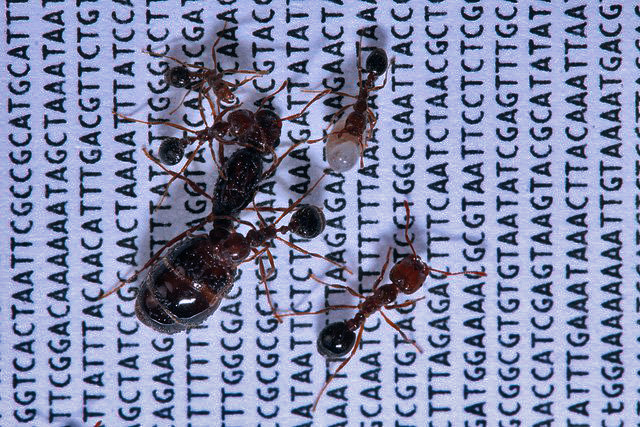 The behavioral evolution in the red fire ant species, which has two distinct types of colonies —one with a single queen and one with multiple queens —has long puzzled biologists. An invisible border seems to exist between the two. The male ants quickly destroy the Queen ants that happen to wander between colonies. To understand what evolutionary mechanisms might be at play, molecular scientists have recently turned to the genome.
 The
The  In
In  Charles Darwin