by Richard William Nelson | Jan 11, 2016
 The status of evolution as a science is verging closer to extinction following a workshop in Germany last month. The essence and definition of science were at the center stage at this historic convening of leading physicists and philosophers of science last month.
The meeting convened in the Romanesque-style Ludwig Maximilian University lecture hall. Science writer Natalie Wolchover covered the story for Quanta Magazine, entitled “A Fight for the Soul of Science,” and later reprinted on TheAtlantic.com, entitled “Physicists and Philosophers Hold Peace Talks.”
Continue Reading
by Richard William Nelson | Nov 5, 2015
Evolutionary paradigms are increasingly struggling to survive under the weight of new scientific evidence. The malarial evolution nightmare is the latest. “Think of a deck of cards,” said Dan Larremore in an interview with Quanta Magazine science writer Veronique Greenwood.
“Now, take a pair of scissors and chop the 52 cards into chunks. Throw them in the air. Card confetti rains down, so the pieces are nowhere near where they started. Now tape them into 52 new cards, each one a mosaic of the original cards. After 48 hours, repeat.”
Continue Reading
by Richard William Nelson | Oct 1, 2015
Nothing is simple in biology. Monica Young and Paul Hebert of the Biodiversity Institute of Ontario, Canada, have found within the amino acid sequences of eight-legged critters, known as arachnids, an evolution bug.
In one of the most extensive invertebrate amino acid sequence studies to date, Young and Hebert found highly variable patterns of amino acid sequences in the hemeprotein known as cytochrome C between species. None of Charles Darwin’s continuous “successive, slight” evolutionary changes in more than 4,000 species of arachnids studied were found. The paper, published in the highly respected journal PLOS ONE in August 2015, demonstrates a persistent flaw in the theory of natural selection – the absence of a common ancestor.
Continue Reading
by Richard William Nelson | Sep 3, 2015
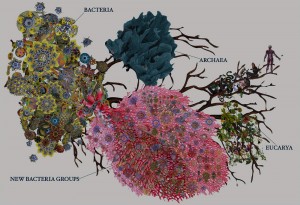
A new and unanticipated evolution dilemma now follows the wake of a massive new microbe discovery. Using a new technique, the number of known bacteria has been “bolstered by almost 50 percent,” according to a new article by Kevin Hartnett published in QuantaMagazine.org and reprinted in ScientificAmerican.com.
With a series of successively smaller porous filters, the University of California Banfield Group at Berkeley discovered a massive number of tiny “bacteria representing > 35 phyla… that consistently distinguished these organisms from other bacteria.”
Continue Reading
by Richard William Nelson | Aug 5, 2015
Sharks get a bad rap. With only a cartilaginous skeleton, sharks were once thought to be the primitive evolution forerunner of the fish originating more than 400 million years ago during the Paleozoic Era―yet somehow surviving unchanged.
Sharks suffer as a stereotypical indiscriminate evolution forerunner, surviving only to kill with unintelligent, deadly instincts. However, a new study on the migratory patterns of the tiger shark, Galeocerdo cuvier, published in the journal Nature, dispels these misconceptions.
Continue Reading

 The status of evolution as a science is verging closer to extinction following a workshop in Germany last month. The essence and definition of science were at the center stage at this historic convening of leading physicists and philosophers of science last month.
 Nothing is simple in biology.