by Richard William Nelson | Jun 11, 2015
 De-extinction is thought to have first appeared, as a word, in The Source of Magic (1979), a science fiction book by Piers Anthony, and caught the attention of Hollywood.
Using ancient cloned dinosaur DNA, popular ER television scriptwriter Michael Crichton then captivated the imagination of American film producer Steven Spielberg with the 1990 novel Jurassic Park, igniting the de-extinction craze.
In 2013, de-extinction was announced to be a science, at least according to journalist Ben Macintyre writing in the Times (London, March 8).
Continue Reading
by Richard William Nelson | Apr 20, 2014
In The Origin of Species, Charles Darwin envisioned that “extinction and natural selection go hand in hand.” Extinction, however, was a relatively new concept, only emerging in revolutionary France following the publication of the Essay on the Theory of the Earth in 1813 by French naturalist Georges Cuvier.
“All these facts, consistent among themselves,” Cuvier argued, “seem to me to prove the existence of a world previous to ours… And what revolution was able to wipe it out [extinction]?”
Cuvier was a renowned French scientist who established the study of extinction as a distinct field of inquiry. When completed in time for the 1889 World’s Fair, his name was one of the only seventy-two names inscribed onto the Eiffel Tower.
Elizabeth Kolbert explains in The Sixth Extinction (2014) that the discovery of extinction made evolution seem “as unlikely as levitation,” an issue Darwin conveniently overlooked.
Continue Reading
by Richard William Nelson | Jul 5, 2013
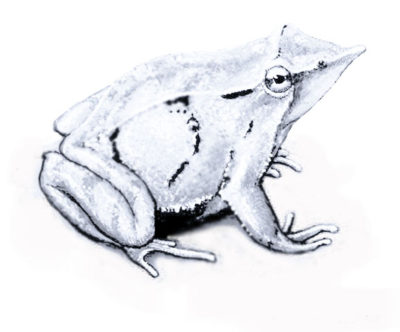
In December 1834, during the five-year voyage of the HMS Beagle, Charles Darwin described the colorings of an unusual frog on the temperate forest Island of Lemuy, Chiloe Archipelago, in his Beagle field notebook. Named in his honor, Rhinoderma darwinii, Darwin’s frog now faces extinction, not evolution.
The only known sister Rhinoderma species, Rhinoderma rufum, was discovered by French zoologist André Marie Constant Duméril (1774 – 1860) in Argentina. In 2004, the International Union for Conservation of Nature (IUCN) listed R. rufum as “critically endangered” and R. darwinii as “vulnerable.”
Continue Reading
by Richard William Nelson | Jul 19, 2010
In The Origin of Species, Charles Darwin wove the eugenic philosophy of Plato into the theory of natural selection. By arguing that “extinction and natural selection go hand in hand,” Darwin legitimized the eugenics movements of the 20th century.
Eugenics originated in ancient cultures. Rome, Athens, and Sparta practiced eugenics to improve the strength and survival of their societies. Encouraged by his brother, Erasmus, Darwin read An Essay on the Principle of Population by Thomas Robert Malthus, an English political economist, in 1838.
Continue Reading

 De-extinction is thought to have first appeared, as a word, in The Source of Magic (1979), a science fiction book by Piers Anthony, and caught the attention of Hollywood.
 In December 1834, during the five-year voyage of the