by Richard William Nelson | May 30, 2010
 In a letter to Sir Joseph Dalton Hooker, his closest friend in 1857, Charles Darwin confided, “I cannot swallow Man [being that] distinct from a Chimpanzee.” Chimp genetics, by extension of Darwin’s theory, were expected to be similar to humans. Charles Darwin writes in his Autobiography –
“My Descent of Man was published in February 1871. As soon as I had become, in the year 1837 or 1838, convinced that species were mutable products, I could not avoid the belief that man must come under the same law.”
Continue Reading
by Richard William Nelson | May 9, 2010
In 1856, just three years before the publication of The Origin of Species by Means of Natural Selection, the first Neanderthal in the fossil record was discovered in the Neander Valley limestone quarry located in Germany.
In The Descent of Man, Darwin argued against the concept that the Neanderthals were humans’ ancestors based on the Neanderthal skull’s larger size. “Nevertheless,” Darwin noted,
“It must be admitted that some skulls of very high antiquity, such as the famous one of Neanderthal, are well developed and capacious.”
Continue Reading
by Richard William Nelson | Apr 18, 2010
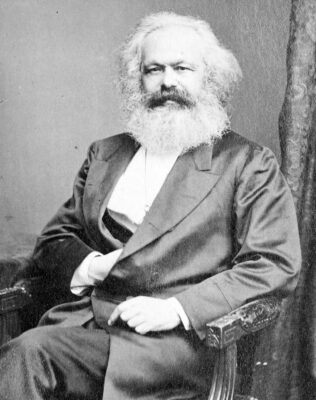
Darwin had a significant influence on Karl Marx (pictured left). Struggle and survival are central to Darwin’s theory of evolution. The full 1859 title of The Origin is – On the Origin of Species by Means of Natural Selection and the Survival of the Fittest in the Preservation of Favoured Races.
Darwin’s premise on survival and struggle in nature paralleled Karl Marx’s premise on social class struggle. Marx summarized the importance of “struggle” in the first line of chapter one of The Communist Manifesto, published in 1848 –
“The history of all hitherto existing society is the history of class struggles.”
Continue Reading
by Richard William Nelson | Apr 4, 2010
Leaving studies in medicine at the University of Edinburgh after the first year and fearing that his son would “ne’er do well,” his father [Robert Darwin], a practicing physician, enrolled Charles at Christ’s College (pictured left), University of Cambridge, in 1827.
His father reasoned that a Bachelor of Arts degree in theology would qualify Darwin to become financially independent as a Church of England clergyman—a guaranteed government professional with a comfortable income.
Continue Reading
by Richard William Nelson | Jan 3, 2010
Michael Ruse, author of the book Defining Darwin, Essays of the History and Philosophy of Evolutionary Biology, concluded that “Indeed, the truth is that there is virtually nothing today in evolutionary studies that correspond exactly to the facts of the Origin.” Molecular clocks are one example.
In the mid-nineteenth century, the idea of molecular clocks was not even remotely considered, not to mention cellular biology or DNA. The scientific revolution had yet to reach into the realm of molecular biology. Case in point, Darwin thought “gemmules” learned by parents were passed on to the next generation through a process of “blending inheritance.”
Continue Reading

 In a letter to Sir Joseph Dalton Hooker, his closest friend in 1857, Charles Darwin confided, “I cannot swallow Man [being that] distinct from a Chimpanzee.” Chimp genetics, by extension of Darwin’s theory, were expected to be similar to humans. Charles Darwin writes in his Autobiography –
 In 1856, just three years before the publication of
  Darwin had a significant influence on