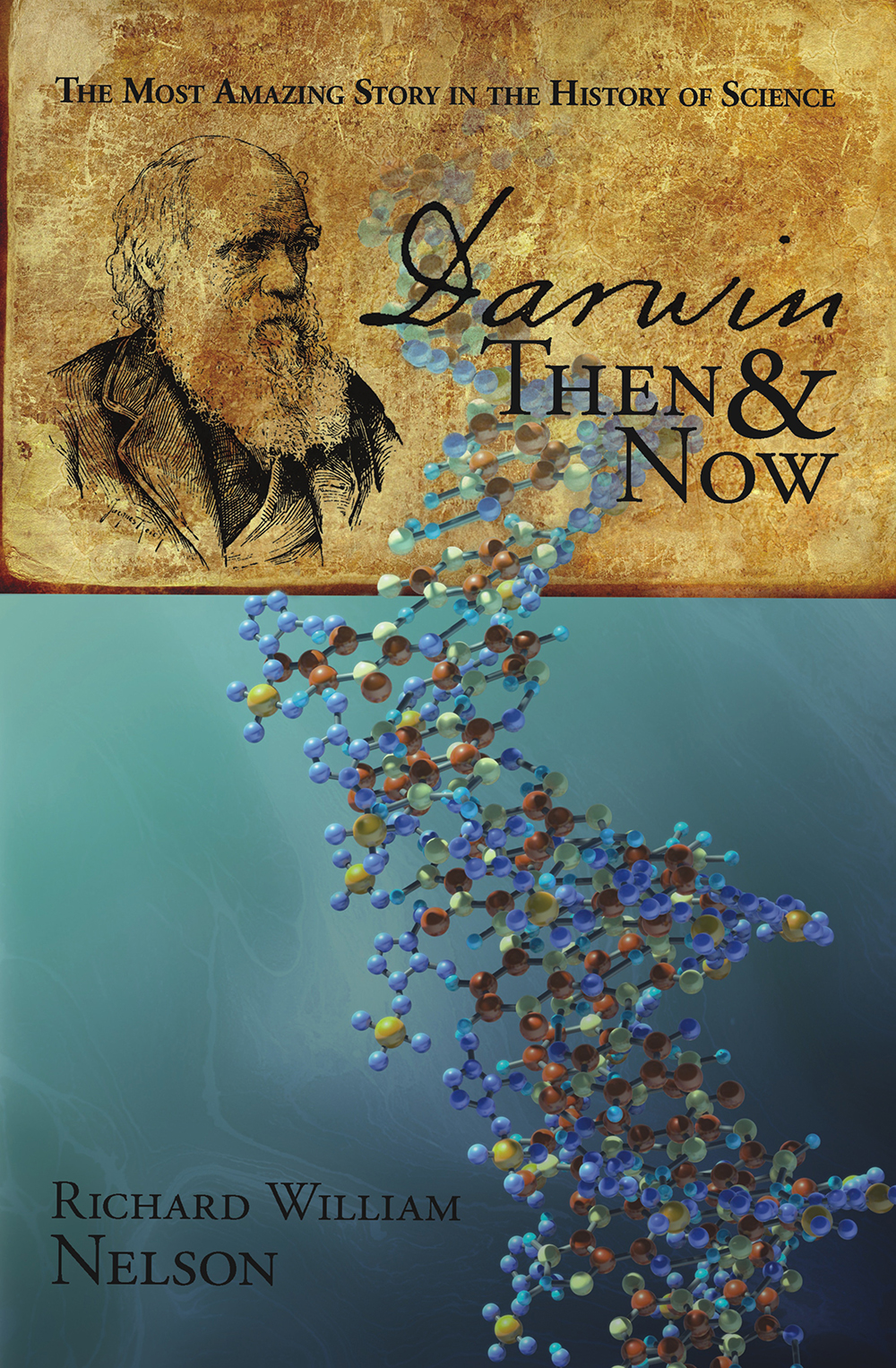
Charles Darwin, in a 1868 letter to Alfred Wallace, acknowledges his contradiction problem –
“Nevertheless, I myself to a certain extent contradict my own remarks.”
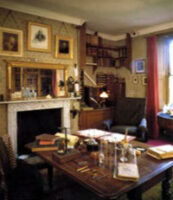
In a library (pictured left), over decades of writing by hand about a concept, Darwin eventually wove his theory of natural selection into a web of contradictions. Any library was no match for a modern laboratory. Understandably, his revolutionary concept was founded on logical grounds rather than on scientific empirical observations of nature.
Darwin’s resulting contradictions illustrate the problem of working “beyond the bounds of science” by relying on layers of assumptions to understand how nature works.
Over the course of decades of writing, Darwin entangled the following 15 evolutionary concepts into logical contradictions.
Darwin’s Contradictions
Darwin developed natural selection into a grand explanatory system, even as its foundations rested on mutually conflicting assumptions about variation, inheritance, and causation. Contradictions in Darwin’s theory illustrate the results of going “beyond the bounds of science.”
Power
“I can see no limit to this power, in slowly and beautifully adapting each form to the most complex relations of life.”
Contradicted by:
“If the numbers be wholly kept down by the causes just indicated, as will often have been the case, natural selection will be powerless in certain beneficial directions; but this is no valid objection to its efficiency at other times and in other ways; for we are far from having any reason to suppose that many species ever undergo modification and improvement at the same time in the same area.”
Perfection
“There is no logical impossibility in the acquirement of any conceivable degree of perfection through natural selection.”
Contradicted by:
“Natural selection will not produce absolute perfection, nor do we always meet, as far as we can judge, with this high standard under nature.”
Preservation
“Further we must suppose that there is a power, represented by natural selection or the survival of the fittest, always intently watching each slight alteration.”
Contradicted by:
“Natural selection should not have preserved or rejected each little deviation.”
Mutual Good
“What natural selection cannot do is to modify the structure of one species, without giving it any advantage, for the good of another species.”
Contradicted by:
“Natural selection can and does often produce structures for the direct injury of other animals.”
Economy
“Natural selection acts solely through the preservation of variations in some way advantageous, which consequently endure.”
Contradicted by:
“Variations neither useful nor injurious would not be affected by natural selection.”
Chance
“Mere chance, as we may call it, might cause one variety to differ in some character from its parents, and the offspring of this variety again to differ from its parent in the very same character and in a greater degree; but this alone would never account for so habitual and large a degree of difference as that between the species of the same genus.”
“I was so convinced that not even a stripe of colour appears from what is commonly called chance.”
Contradicted by:
“As many more individuals of each species are born than can possibly survive; and as, consequently, there is a frequently recurring struggle for existence, it follows that any being, if it varies however slightly in any manner profitable to itself, under the complex and sometimes varying conditions of life, will have a better chance of surviving, and thus be naturally selected. From the strong principle of inheritance, any selected variety will tend to propagate its new and modified form.”
Variations Arise Infinitely
“In living bodies, variation will cause the slight alteration, generation will multiply them almost infinitely, and natural selection will pick out with unerring skill each improvement.”
Contradicted by:
“We have seen that species at any one period are not indefinitely variable, and are not linked together by a multitude of intermediate gradations.”
Variations Accumulate Continuously
“I can see no difficulty in natural selection preserving and continually accumulating variations.”94 And, “An extraordinary amount of modification implies an unusually large and long-continued amount of variability, which has continually been accumulated by natural selection for the benefit of the species.
Contradicted by:
“Natural selection has succeeded in giving a fixed character to the organ, in however extraordinary a manner it may have been developed.”96 And, “From the fact of the above characters being unimportant for the welfare of the species, any slight variations which occurred in them would not have been accumulated and augmented through natural selection.”
Natural selection Causes Variability
“In one sense the conditions of life may be said not only to cause variability, either directly or indirectly, but likewise to include natural selection.”
Contradicted by:
“Some have even imagined that natural selection induces variability, whereas it implies only the preservation of such variations.”
Natural Selection Overcomes Variability
“… natural selection having more or less completely, according to the lapse of time, overmastered the tendency to reversion and to further variability.”
Contradicted by:
“For variation is a long-continued and slow process, and natural selection will in such cases not as yet have had time to overcome the tendency to further variability.”
Efficiency
“For the best definition which has ever been given of a high standard of organisation, is the degree to which the parts have been specialised or differentiated; and natural selection tends towards this end, since the parts are thus enabled to perform their functions more efficiently.”31
Contradicted by:
“Natural selection either has not or cannot come into full play, and thus the organisation is left in a fluctuating condition.”
Transitional Links
“By the theory of natural selection, all living species have been connected with the parent-species of each genus, by differences not greater than we see between the natural and domestic varieties of the same species at the present day … So that the number of intermediate and transitional links, between all living and extinct species, must have been inconceivably great. But assuredly, if this theory be true, such have lived upon the Earth.”
Contradicted by:
“We have seen that species at any one period are not indefinitely variable, and are not linked together by a multitude of intermediate gradations.”
Extinction
“Lastly, looking not to any one time, but at all time, if my theory be true, numberless intermediate varieties, linking closely together all the species of the same group, must assuredly have existed; but the very process of natural selection constantly tends, as has been so often remarked, to exterminate the parent-forms and the intermediate links.”
Contradicted by:
“On our theory, the continued existence of lowly organisms offers no difficulty; for natural selection, or the survival of the fittest, does not necessarily include progressive development—it only takes advantage of such variations as [they] arise and are beneficial to each creature under its complex relations of life.”
Natural Selection
“On the theory of natural selection, we can clearly understand the full meaning of that old canon in natural history.”
Contradicted by:
“Natural selection, and likewise, because this is by far the most serious special difficulty which my theory has encountered.”
Paleontology
“Passing from these difficulties, the other great leading facts in paleontology agree admirably with the theory of descent with modification through variation and natural selection.”
Contradicted by:
“Existence of many links … does not yield the infinitely many fine gradations between past and present species required on the theory.”
Natural Selection, Logic or Law of Nature
Darwin did not develop his natural selection concept based on systematic empirical observations, as did Isaac Newton in physics. The concept of natural selection was founded on a “belief.” As Darwin explains –
“The theory of natural selection is grounded on the belief that each new variety and ultimately each new species is produced and maintained by having some advantage over those with which it comes into competition.”
Darwin entangled his concepts of natural selection into a maze of logical inconsistencies and explicit and implicit contradictions. A deductive causal narrative was stitched together from evidence that could not sustain the mechanisms he proposed. For good reasons, Darwin conceded –
“Natural selection … is by far the most serious special difficulty which my theory has encountered.”
Failure to define a concept’s framing concepts violates fundamental scientific principles; Darwin never even defined “natural selection.”
However, Darwin did include a falsifiability test for his theory, noting –
“If numerous species, belonging to the same genera or families, have really started into life at once, the fact would be fatal to the theory of evolution through natural selection.”
Fossil evidence has since demonstrated that the lineages of Earth’s animals emerged as a burst of life, e.g., the Cambrian Explosion. The fossil record alone undermines his theory of biological evolution.
“Beyond the Bounds”
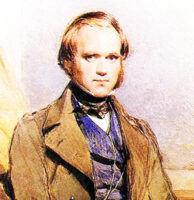
In a 1857 letter to the most famous American botanist of the 19th century, Asa Gray, Darwin acknowledged –
“I am quite conscious that my speculations run quite beyond the bounds of true science.”
Before the publication of The Origin of Species, Darwin was awarded a Royal Medal by the Royal Society in 1853. However, Darwin never again received an award from any scientific organization.
The fusion of two distinct processes — the origin of species and the preservation of favored races — into a single mechanism, even though the logic of each process differs. Darwin insisted natural selection was not anthropomorphic, yet he repeatedly described it using agent-like language (“selects,” “scrutinizes,” “rejects”), creating a conceptual contradiction between metaphor and mechanism.
For these reasons, Darwin’s explanation of natural selection has never been recognized as a scientifically valid evolutionary concept, either then or now.
Tangled Contradictions is a subcategory of Natural Selection.
Darwin Then and Now is an educational resource on the intersection of evolution and science, highlighting the ongoing challenges to the theory of evolution.
Move On
Explore how to understand twenty-first-century concepts of evolution further using the following links –
-
- The Understanding Evolution category showcases how varying historical study approaches to evolution have led to varying conclusions. Subcategories include –
- Studying Evolution explains how key evolution terms and concepts have changed since the 1958 publication of The Origin of Species.
- What is Science explains Charles Darwin’s approach to science and how modern science approaches can be applied for different investigative purposes.
- Evolution and Science feature study articles on how scientific evidence influences the current understanding of evolution.
- Theory and Consensus feature articles on the historical timelines of the theory and Natural Selection.
- The Biography of Charles Darwin category showcases relevant aspects of his life.
- The Glossary defines terms used in studying the theory of biological evolution.
- The Understanding Evolution category showcases how varying historical study approaches to evolution have led to varying conclusions. Subcategories include –