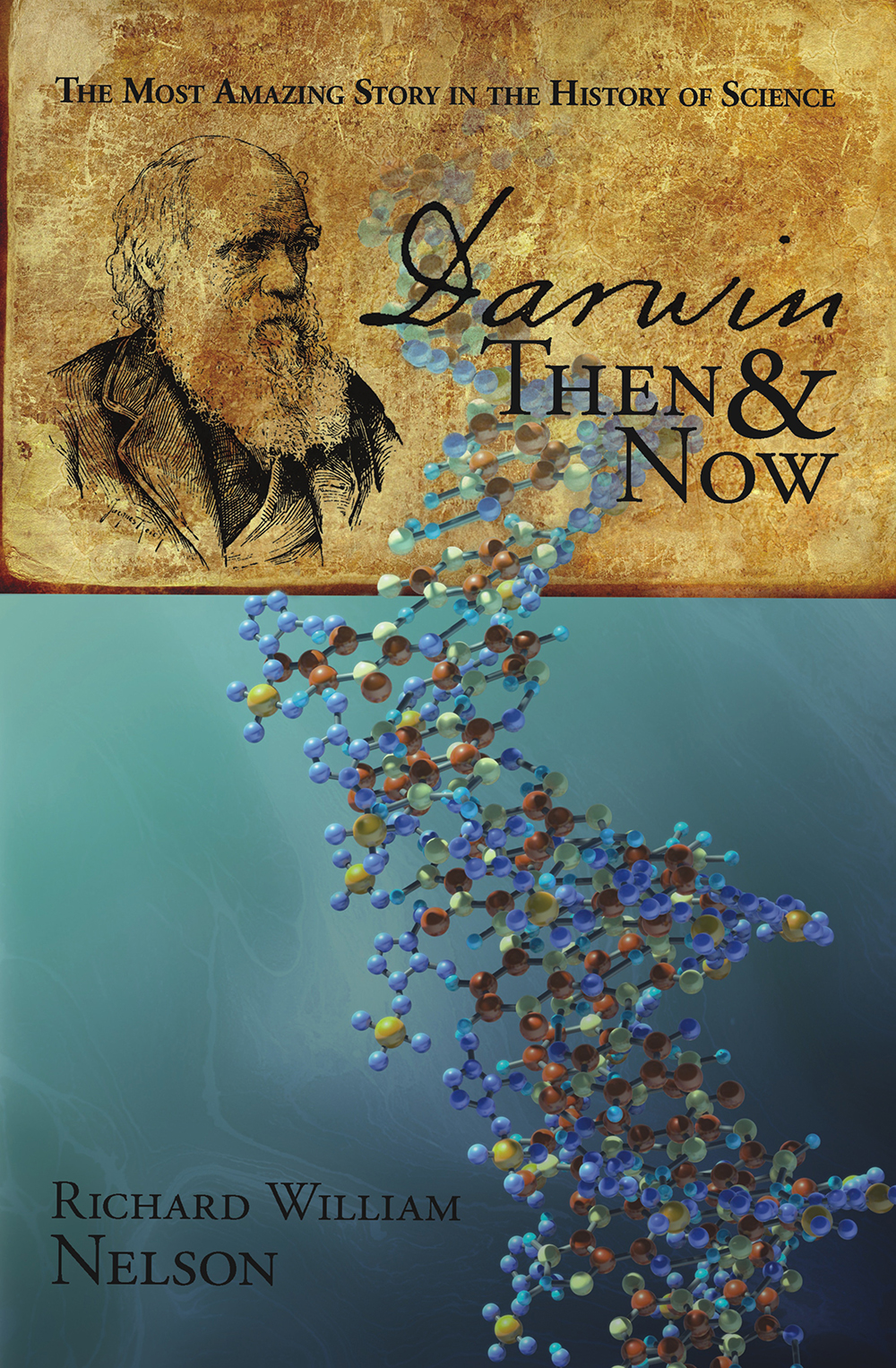
Popularly, Charles Darwin is credited as the first to use the phrase “natural selection” in the context of biological evolution. While Darwin first used this phrase in his 1842 “brief abstract,” he did not publicly introduce it until The Origin of Species was published in 1859.
However, contemporary naturalists, including Charles Naudin, Alfred Wallace, and Patrick Matthew, used “natural selection-like” phrases to describe parallel concepts.
Charles Victor Naudin
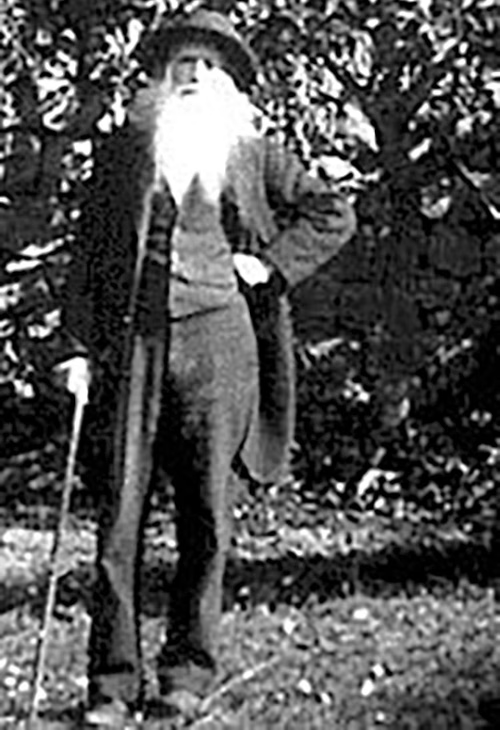
In 1852, French botanist Charles Victor Naudin (pictured right) was the first to envision a link between selection and evolution. However, the link was just an abstract concept. Beyond this shortcoming, Darwin credits Naudin’s work in The Origin of Species (1859), noting –
“In 1852, M. Naudin, a distinguished botanist, expressly stated… his belief that species are formed in an analogous manner as varieties are under cultivation; and the latter process he attributes to man’s power of selection. But he does not show how selection acts under nature.”
Two other naturalists, Alfred Russel Wallace and Patrick Matthew, are credited by Darwin for independently developing similar concepts of natural selection before 1859.
Alfred Russel Wallace
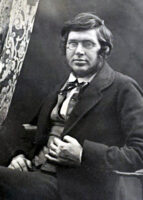 Wallace (pictured left), while working in Sarawak on the island of Borneo, published a paper in February 1855. The paper, “On the Law which has Regulated the Introduction of New Species,” was published in the Annals and Magazine of Natural History. Wallace’s concept became known as the “Sarawak Law,” arguing –
“Every species has come into existence coincident in time & space with preexisting species.”
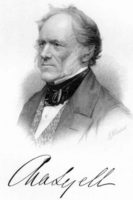 Darwin’s long-time confidant, Charles Lyell (pictured right), alerted Darwin to Wallace’s published similarities. Darwin recalls Lyell’s advice in his Autobiography –
“Early in 1856, Lyell advised me to write out my views pretty fully, and I began at once to do so on a scale three or four times as extensive as that which … followed in my Origin of Species.”
Wallace’s development of his “New Species” concept impressed Darwin, and he considered him an intellectual ally. Since his return to England, Darwin relied on observations sent from contacts around the world. In May 1857, Darwin sent an encouraging letter to Wallace stating –
“By your letter & even still more by your paper in Annals, a year or more ago, I can plainly see that we have thought much alike & to a certain extent have come to similar conclusions.”
Over the years, Darwin and Wallace exchanged more than 90 letters. To encourage using his approach, Darwin wrote to Wallace in December 1857 –
“Without speculation there is no good and original observation… I believe I go much further than you.”
Speculations play an important role in science, but only to a point.
Linnean Society
In February 1858, Wallace sent Darwin his latest, “On the Tendency of Varieties to Depart Indefinitely From the Original Type“. This time, Wallace asked Darwin to give it to Lyell, for presentation at the next Linnean Society meeting, which Darwin did.
Acknowledging the surprising similarities to his theory, Darwin notes that the effect of Wallace’s 1858 letter in his Autobiography –
“But my plans were overthrown, for in the early summer of 1858, Mr. Wallace, who was then in the Malay Archipelago, sent me an essay On the Tendency of Varieties… this essay contained exactly the same theory as mine.”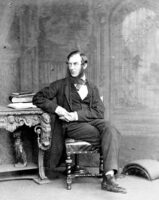
Lyell and Joseph Hooker (pictured right) arranged for reading Wallace’s paper and Darwin’s 1844 Essay on August 20, 1858. Surprisingly, neither paper generated any discussion. Thomas Bell, the Society’s president, noted in his annual report that nothing of importance had happened during the year.
Interestingly, Darwin did not publish the phrase until November 1859 in The Origin of Species. Wallace never used the phrase “natural selection” until 1866 in his book The Scientific Aspect of the Supernatural.
The Matheus Influence
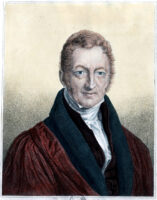 To conceptualize a selection process for evolution, both Darwin and Wallace had been influenced by Thomas Robert Malthus (pictured left). Malthus was an English political economist.
In his autobiography, entitled My Life (1905), Wallace describes how he was influenced by Malthus’s 1798 essay, noting –
“One day, something brought to my recollection Malthus’s ‘Principles of Population,’ which I had read about twelve years before. I thought of his clear exposition of ‘the positive checks to increase’ – disease, accidents, war, and famine – which keep down the population of savage races to so much lower an average than that of more civilized peoples.”
Wallace continued, “without which I should probably not have hit upon the theory of natural selection.” The origins of an evolutionary “selection” process for Darwin and Wallace emerged from a political economy model.
Darwin’s and Wallace’s concept of natural selection originated in Malthus’ behavioral economics model, not in scientifically testable empirical evidence.
However, an earlier naturalist, Patrick Matthew (1790-1874), independently contributed to the theory of natural selection, without drawing on Malthus’ 1798 Essay.
Patrick Matthew
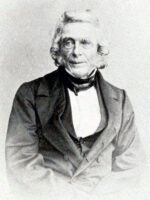 Twenty-eight years before the publication of The Origin of Species, Matthew preceded Darwin’s “survival of the fittest” argument in his 1831 book entitled “On Naval Timber, and Arboriculture” –
“As Nature, in all her modifications of life, has a power of increase far beyond what is needed.”
Compared to “selection by the law of nature,” Mathew viewed artificial selection as destructive, arguing –
“As far back as history reaches, man had already had considerable influence… occasioning the destruction of many species… not having undergone selection by the law of nature.”
Matthew understood natural selection from agricultural and ecological observation, not from population economics or demographic theory. Initially, Darwin denied reading Matthew. However, beginning with his 3rd Edition in 1861, Darwin comments on Matthew’s work, noting –
“The differences of Mr. Matthew’s view from mine are not of much importance: he seems to consider that the world was nearly depopulated at successive periods… He clearly saw, however, the full force of the principle of natural selection.”
Thomas Robert Malthus, Alfred Russel Wallace, and Patrick Matthew predated Darwin’s 1842 “brief abstract” and applied near-identical concepts to describe his theory of natural selection; the theory was popular long before the publication of The Origin of Species in 1858.
Parallel Natural Selection Theories is a subcategory of Natural Selection.
Darwin Then and Now is an educational resource on the intersection of evolution and science, highlighting the ongoing challenges to the theory of evolution.
Move On
Explore how to understand twenty-first-century concepts of evolution further using the following links –
-
- The Understanding Evolution category showcases how varying historical study approaches to evolution have led to varying conclusions. Subcategories include –
- Studying Evolution explains how key evolution terms and concepts have changed since the 1958 publication of The Origin of Species.
- What is Science explains Charles Darwin’s approach to science and how modern science approaches can be applied for different investigative purposes.
- Evolution and Science feature study articles on how scientific evidence influences the current understanding of evolution.
- Theory and Consensus feature articles on the historical timelines of the theory and Natural Selection.
- The Biography of Charles Darwin category showcases relevant aspects of his life.
- The Glossary defines terms used in studying the theory of biological evolution.
- The Understanding Evolution category showcases how varying historical study approaches to evolution have led to varying conclusions. Subcategories include –