 Dating the age of Earth’s biosphere is a complex process. The current consensus on the age of our solar system and the Earth is around 4.54 billion years for the Earth, indicating that both had a definitive beginning in time.
This concept of a beginning in time is among modern science’s most secure conclusions and provides a foundation for dating the Earth’s age. However, establishing the age of Earth’s biosphere is vastly more complicated than establishing that our solar system and universe had a beginning.
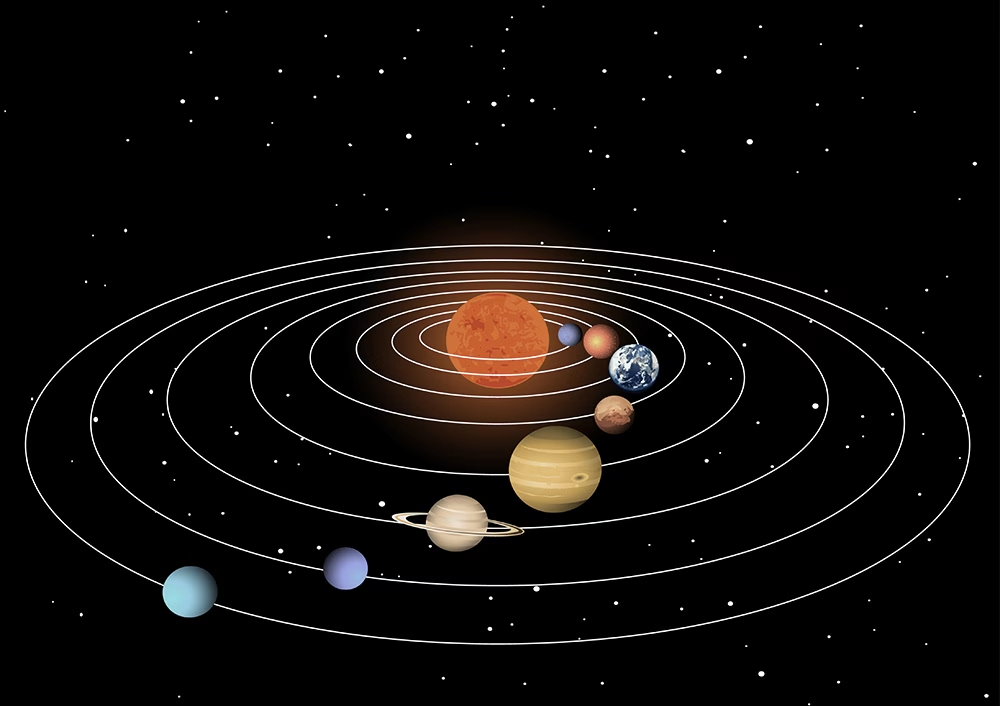 While the beginning of our solar system is characterized by a single mathematical model, calculating the age of Earth’s biosphere requires integrating a vast number of diverse, yet unknown, physical and biological factors, each with distinct principles and assumptions. The age of Earth’s biosphere is not governed by any single unifying theory.
Estimating the age of Earth’s biosphere, therefore, is a complex inferential process that requires integrating multiple lines of evidence with different inferential logics, each with inherently different levels of uncertainty.
Scientific Consensus
 Organizations often issue consensus statements when the statements are compatible with the evidence. NASA, the American Geophysical Union, and the American Association for the Advancement of Science concur that the estimated age of Earth is 4.54 billion years old.
Currently, however, no scientific organization recognizes any framework for integrating distinct lines of evidence to unify biosphere‑dating methods. Therefore, there is currently no consensus on the age of Earth’s biosphere among modern scientific organizations.
Lines of Evidence
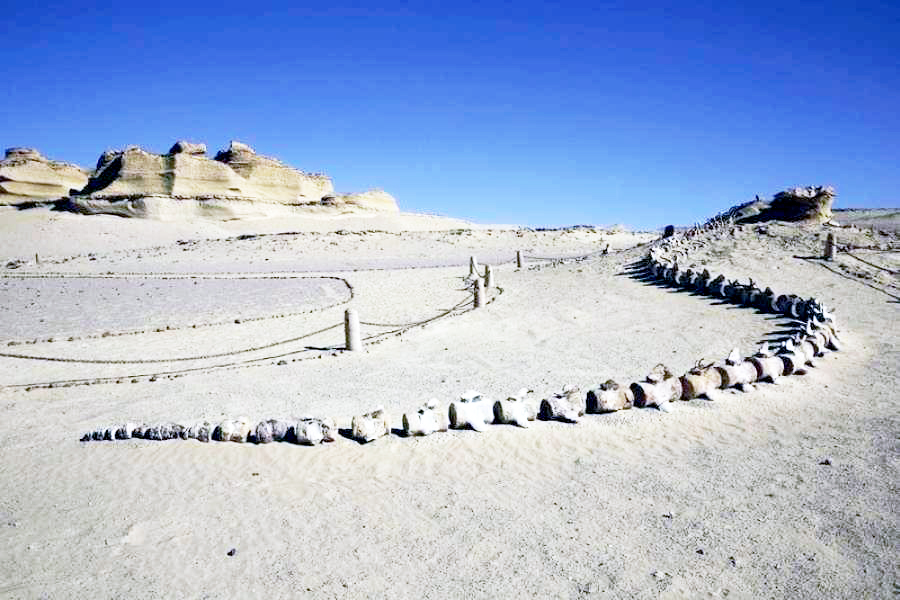 The complicating factor in dating is the heterogeneous nature of Earth’s biosphere, from inorganic elements to complex reproductive systems. Since the networks of each line are partially independent yet partially interdependent, trials of numerous approaches have yet to yield any consistent unifying age.
These heterogeneous lines of evidence continue to stymie efforts to develop a consensus framework for scientifically studying the age of Earth’s biosphere. Studying the age of Earth’s biosphere has moved beyond the deductive and inductive reasoning principles of the Scientific Method and incorporates epistemic reasoning.
Epistemic Reasoning
The framework of epistemic reasoning differs from deductive and inductive reasoning, beginning only with a belief. This belief may be founded on an integration of perceptions, inferences, and/or reasoning.
 However, since the integration of these processes may not be testable, epistemic reasoning introduces measures of uncertainty that the belief is true.
Consequently, twenty-first-century scientific organizations have refrained from issuing a consensus framework for dating Earth’s biosphere. Uncertainties pervade dating the Earth’s biosphere.
The Scientific Method has zero tolerance for uncertainties, as expressed by Albert Einstein (pictured left)-
“No amount of experimentation can ever prove me right; a single experiment can prove me wrong.”
Uncertainties
 Uncertainties undermine attempts to scientifically ascribe an age to Earth’s biosphere. The source of these dating uncertainties are rooted in four sources: definitions and conceptual framework, measurements, regional variations, and dating methods –
- Definitions and Conceptual Frameworks
Terminological Ambiguity: Terms including “stage,” “epoch,” and “event” have different meanings across disciplinary contexts (e.g., paleontology vs. sedimentology).
Boundary Criteria: The definition of boundaries (e.g., base of the Cambrian) hinges on biostratigraphic markers that are not globally synchronous.
Circularity Risk: Definitions can rely on fossil assemblages that are themselves dated using the very frameworks they help construct.
- Measurements
Unit Inconsistencies: Differences in isotopic standards, decay constants, or calibration curves lead to divergent age estimates.
Precision vs. Accuracy: High-precision measurements (e.g., Uranium-Lead dating) can be inaccurate when underlying assumptions (e.g., closed system behavior) are violated.
- Regional Variations
Diachronous Markers: Fossil taxa or lithological features appear at different times in different regions due to ecological or depositional factors.
Regional Variations: Stratigraphic markers—like fossil assemblages or lithological features—vary dramatically across continents and between studies.
Facies Dependency: Lithostratigraphic units are facies-dependent, complicating global correlation.
- Dating Methods
Chronostratigraphy vs. Geochronology: Rock-based and time-based frameworks diverge, especially in fossil-poor intervals.
Technical Methods: The types of technical methods, including radiometric dating, magnetostratigraphy, chemostratigraphy, molecular dating, and astrochronology, vary across studies and evidence types.
Calibration Conflicts: Fossil calibration points used in molecular clocks often conflict with radiometric dates, raising questions about which framework to privilege.
Technical Challenges: As new technologies emerge, the parameters of the independent variables must be recalibrated and standardized. Importantly, the new data can be incompatible with older technologies.
This heterogeneity of evidence sources prevents the integration of these beliefs into a single, coherent chronological model and consequently an establishment Earth’s biosphere age.
Timeframe Charts
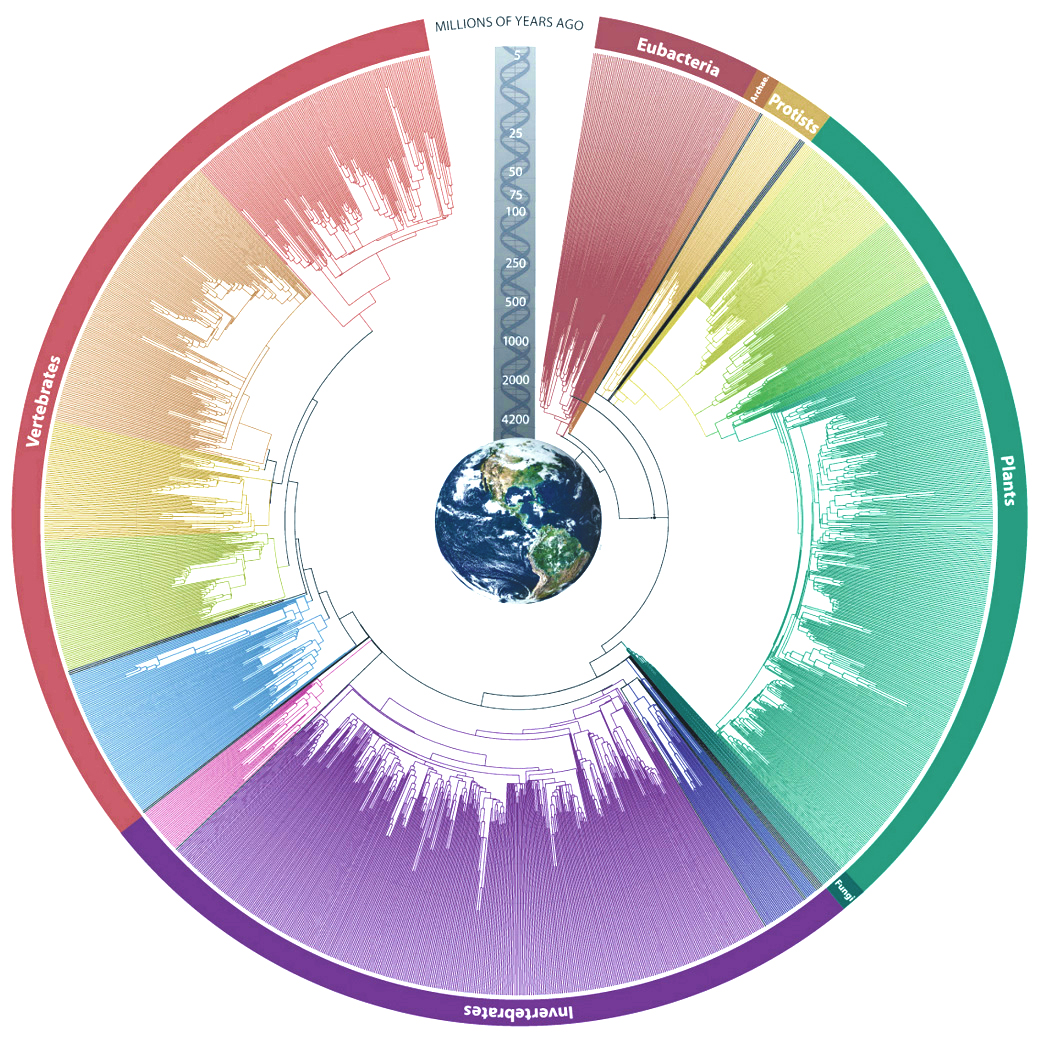
Twenty‑first‑century scientific organizations have refrained from issuing any consensus framework for dating Earth’s biosphere, however, a few organizations have published geological timeframe charts (pictured right).
The International Commission on Stratigraphy (ICS), is recognized as publishing the most authoritative charts. However, a consensus on managing uncertainties and verifying compliance has yet to be developed. In acknowledging these uncertainties, ICS includes the following disclaimer on its charts –
“Numerical ages are subject to ongoing revision and do not define units…”
Therefore, even geological timeframe charts must be be understood as speculations of Earth’s age, rather than definitive, scientifically validated timelines.
Timeframe for Earth’s Biosphere
The prospects of developing a scientifically testable timeframe for Earth’s biosphere is low with the current scientific tools and conceptual frameworks. The reason is structural evidence, not merely technical.
 Establishing a timeframe for Earth’s biosphere remains beyond the each of science. The twenty-first-century evidence is compatible with the Genesis account written by Moses –
“In the beginning God created the heaven and the earth… And God saw every thing that he had made, and, behold, it was very good. And the evening and the morning were the sixth day.”
Dating Earth’s Reasoning is a subcategory of What is Science.
More
Scientific methods may use different reasoning processes, including –
-
- Inductive vs. Deductive Reasoning
- Circular Reasoning
- Epistemic Reasoning
- Dating Earth’s Biosphere (current page)
Darwin Then and Now is an educational resource on the intersection of evolution and science, highlighting the ongoing challenges to the theory of evolution.
Move On
Explore how to understand twenty-first-century concepts of evolution further using the following links –
-
- Understanding Evolution category showcases how varying historical study approaches to evolution have led to varying conclusions. Subcategories include –
- Studying Evolution explains how key evolution terms and concepts have changed since the 1958 publication of The Origin of Species.
- What is Science (current category) explains Charles Darwin’s approach to science and how modern science approaches can be applied for different investigative purposes.
- Evolution and Science feature articles on how scientific evidence influences the current understanding of evolution.
- Theory and Consensus feature articles on the historical timelines of the theory and Natural Selection.
- The Biography of Charles Darwin category showcases relevant aspects of his life.
- Glossary defines terms used in studying the theory of biological evolution.
- Understanding Evolution category showcases how varying historical study approaches to evolution have led to varying conclusions. Subcategories include –