by Richard William Nelson | Nov 6, 2012
 Scientists last week proposed new evolutionary relationships among all 9,993 of the world’s known living bird species. In a letter published in the prestigious Nature journal, scientists reported on the use of DNA-sequence data to create a radiating phylogenetic tree, a revolutionary new bird tree of life (pictured left).
Walter Jetz (pictured right), an evolutionary biologist at Yale University in New Haven, Connecticut, was the leading author of the letter entitled “The global diversity of birds in space and time.” In an interview with science writer Virginia Gewin for Nature News, Jetz explains –
“This is the first dated tree of life for a class of species this size to be put on a global map.”
Continue Reading
by Richard William Nelson | Sep 18, 2012
The junk DNA theory was introduced in 1972 by evolutionary geneticist Susumu Ohno in the paper entitled “So Much ‘Junk’ in Our Genome.”
The junk comprises sections in the genome with no discernible function, it was thought. Previously, in 1970, Ohno gained notoriety for his gene duplication-driven theory, presented in his book, Evolution by Gene Duplication.
Continue Reading
by Richard William Nelson | Sep 5, 2012
Exploring human evolution via DNA was essential for twentieth-century evolution scientists. Charles Darwin, however, in The Origin of Species, never used the terms genetics, genetic, and genes until 1872, following the publication of the pea plant inheritance report of Gregor Mendel in 1866.
In his sixth edition, Darwin used the term “genetic” twice, but only to express a genealogical idea, not as a molecular term. In the words of American evolutionary biologist Richard Lewontin,
“Darwin knew nothing about genes.”
Continue Reading
by Richard William Nelson | Jul 24, 2012
Deciphering evidence for sea star evolution has long intrigued biologists. To explore speciation between two similar-looking sea stars, Jonathan Puritz (pictured below) of the Institute of Marine Biology at the University of Hawaii coordinated a research team to correlate the genetic and geographic differences between two Coral Sea species.
The team’s report, entitled “Extraordinarily rapid life-history divergence between Cryptasterina sea star species,” was published last week in the Proceedings of the Royal Society.
Continue Reading
by Richard William Nelson | Mar 13, 2012
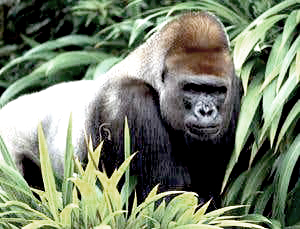
The “Insights into hominid evolution from the gorilla genome sequence” report, published by the British journal Nature this last week, stands as a historical milestone in the study of human origins, sequencing the gorilla genome.
Aylwyn Scally (pictured right below) at the Wellcome Trust Sanger Institute led the research team to complete the gorilla genome sequence project, the last genus of the living great apes to have its genome decoded. The use of gorilla genome sequences, Scally explains –
“Will promote a deeper understanding of great ape biology and evolution.”
The findings change the evolution narrative.
Continue Reading

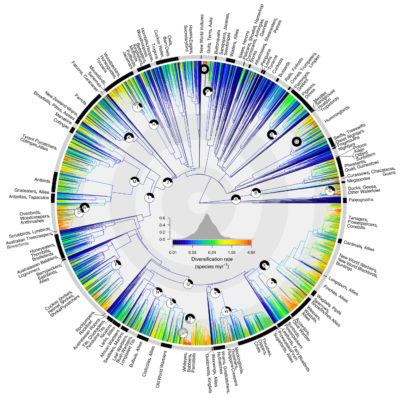 Scientists last week proposed new evolutionary relationships among all 9,993 of the world’s known living bird species. In a letter published in the prestigious Nature journal, scientists reported on the use of DNA-sequence data to create a radiating phylogenetic tree, a revolutionary new bird tree of life (pictured left).
 The junk DNA theory was introduced in 1972 by evolutionary geneticist
  Exploring human evolution via DNA was essential for twentieth-century evolution scientists.
 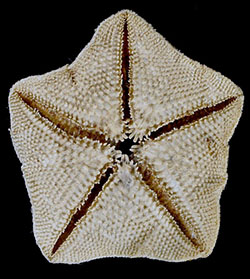 Deciphering evidence for sea star evolution has long intrigued biologists. To explore speciation between two similar-looking sea stars,
  The “Insights into hominid evolution from the gorilla genome sequence”