by Richard William Nelson | Jun 6, 2010
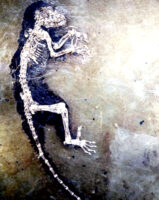
 This is the story of the Ida Fossil Fiasco. “This little creature is going to show us our connection with the rest of all the mammals, with cows and sheep, and elephants and anteaters,” said Sir David Attenborough, who narrated the BBC documentary in May 2009.
“The more you look at Ida, the more you can see, as it were, the primate in embryo.”
Really? According to Jørn Hurum, the paleontologist from Oslo University’s Natural History Museum, who assembled the scientific team –
“It tells a part of our evolution that’s been hidden so far. It’s been hidden because the only [other] specimens are so incomplete and so broken there’s almost nothing to study.”,
Continue Reading
by Richard William Nelson | May 9, 2010
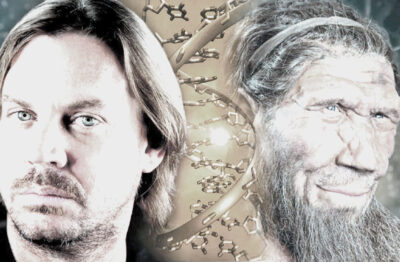
In 1856, just three years before the publication of The Origin of Species by Means of Natural Selection, the first Neanderthal in the fossil record was discovered in the Neander Valley limestone quarry located in Germany.
In The Descent of Man, Darwin argued against the concept that the Neanderthals were humans’ ancestors based on the Neanderthal skull’s larger size. “Nevertheless,” Darwin noted,
“It must be admitted that some skulls of very high antiquity, such as the famous one of Neanderthal, are well developed and capacious.”
Continue Reading
by Richard William Nelson | Apr 18, 2010
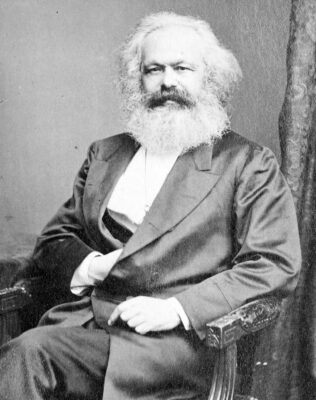
Darwin had a significant influence on Karl Marx (pictured left). Struggle and survival are central to Darwin’s theory of evolution. The full 1859 title of The Origin is – On the Origin of Species by Means of Natural Selection and the Survival of the Fittest in the Preservation of Favoured Races.
Darwin’s premise about survival and struggle in nature paralleled Karl Marx’s premise about class struggle. Marx summarized the importance of “struggle” in the first line of chapter one of The Communist Manifesto, published in 1848 –
“The history of all hitherto existing society is the history of class struggles.”
Continue Reading
by Richard William Nelson | Mar 21, 2010
A consensus understanding of Charles Darwin’s theory of natural selection varies even among evolutionary scientists. Richard Dawkins (pictured left), in his “Illusion of Design” paper originally published in the Natural History Magazine, envisioned natural selection as –
“Non-random survival of randomly varying hereditary instructions.”
While Dawkins’ explanation of natural selection is widely held, developing a consensus among evolutionary scientists remains contentious. In reference to an understanding of natural selection, Darwin conceded –
“No one definition has satisfied all naturalists.”
Continue Reading
by Richard William Nelson | Jan 3, 2010
Molecular clocks played a significant role in the search for evidence of biological evolution over the past seventy-five years. Driven by biotechnological advances, the integration of molecules with morphology reflects the shift from Darwinism to the Modern Synthesis theory of evolution.
Early formulations of the molecular-clock concept assumed that biological molecules—DNA, RNA, and proteins—accumulated sequence changes at consistant rates. These changes were envisioned to as chronological signatures within a lineage, similar to growth rings in a tree trunk. By tracing the order and magnitude of these changes, researchers expected to reconstruct the evolutionary history of each species.
Continue Reading

 This is the story of the Ida Fossil Fiasco. “This little creature is going to show us our connection with the rest of all the mammals, with cows and sheep, and elephants and anteaters,” said Sir David Attenborough, who narrated the BBC documentary in May 2009.
 In 1856, just three years before the publication of
  Darwin had a significant influence on
  A consensus