 Natural explanations for the origin of life did not begin with Charles Darwin. The history of evolutionary concepts spans an intellectual arc from ancient speculations to scientific discoveries about the nature of life.
How life emerged is one of the universe’s greatest mysteries. Understanding the arc’s progression gives insight into the intellectual history of evolutionary concepts. Of these, natural selection was the first logical framework capable of scientific testing.
Since the twentieth century, Darwin’s framework has served as a foundation in modern biology. However, more recent technological advances have provided empirical tools to scientifically test the validity of Darwin’s framework.
The arc is continuous but not uniform, each contributing to understanding Earth’s unparalleled natural history.
Greek Philosophy
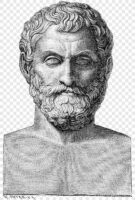
Greek philosophers developed the earliest concepts of biological evolution. Anaximander of Miletus (610–546 BC – pictured above) is credited as the first to propose a physical mechanism for the emergence of life, arguing –
“Life had evolved from moisture.”
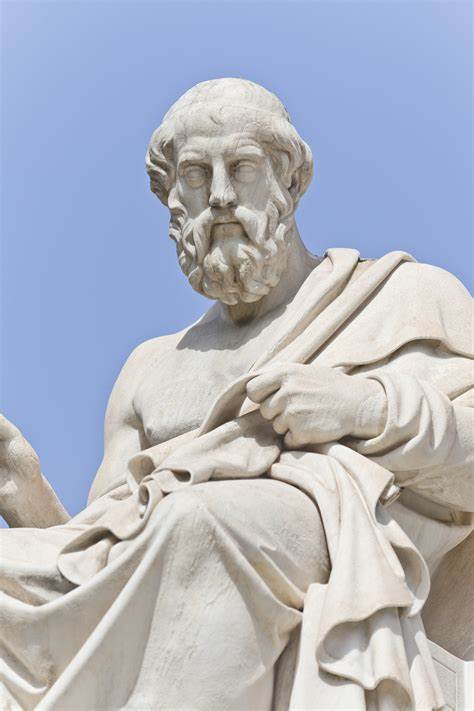 Aristotle (384–322 BC/pictured right) advanced a philosophical framework grounded in teleology, arguing that “nature does nothing in vain.” Unlike Anaximander, Aristotle viewed life as purposeful.
Under the influence of Aristotle, the evolutionary arc in Western academia continued into the eighteenth and twentieth centuries. The topic of evolution was popular and controversial long before the publication of “The Origin of Species.”
The Darwin’s
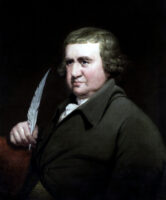 Darwin’s grandfather, Erasmus Darwin (pictured left), as a physician, poetically characterized the origins of life in “Zoonomia, or the Laws of Organic Life” (1794), noting –
“Organic Life beneath the shoreless waves, Was born and nurs’d in Ocean’s pearly caves… These are successive generations bloom.”
 Darwin resumed his grandfather’s pursuit to explore natural explanations for the origin of life, while a fine-arts student at Christ’s College, Cambridge, England. Approaching graduation, the opportunity to travel the globe to pursue his passion was too good to pass-up, despite his father’s stern disapproval.
Two years after returning on the H.M.S. Beagle in 1835, Darwin began documenting his work in a notebook labeled “B” (pictured left). The notebook, dated “July 1837”; was labeled “Zoonomia” on the title page.
However, identifying a causative mechanism capable of driving evolution remained elusive. A seemingly logical mechanism did not come into focus until reading a book on population growth the following year. As Darwin explains in his Autobiography –
“In October 1838 … I happened to read for amusement Malthus On Population… it at once struck me that under these circumstances, favorable variations would tend to be preserved, and unfavorable ones to be destroyed. The result of this would be the formation of new species.”
Thomas Malthus
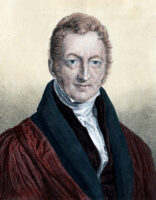 Thomas Robert Malthus (pictured left), an English political economist, influenced how intellectuals viewed the challenges of sharing life on Earth. In his book, An Essay on the Principle of Population, Malthus explains how growing populations would eventually exceed Earth’s available resources.
As competition for limited resources increases, populations will increasingly struggle to survive. Darwin and Malthus drew on Malthus’ ideas in developing the concept of natural selection—which emphasizes competition for survival. The complete title of Darwin’s work reflects Malthus’ influence —
On the origin of species by means of natural selection, or the preservation of favoured races in the struggle for life.
To survive, populations must adapt to life’s increasing challenges. However, Darwin extended the reasoning further: the accumulation of adaptions over periods of time drives the formation of new species.
While “struggle” is a logical answer to the “why evolution” must work, the “how evolution” question remained unanswerable. The answer to the “how question” requires a testable empirical causal mechanism. But, one was not known of at the time.
Causal Mechanism
Variations observed in the Galapagos finches eventually played a central role in developing an empirical causal mechanism. The differing beak sizes were assumed to stem from the actions of natural selection “in the struggle for life.”
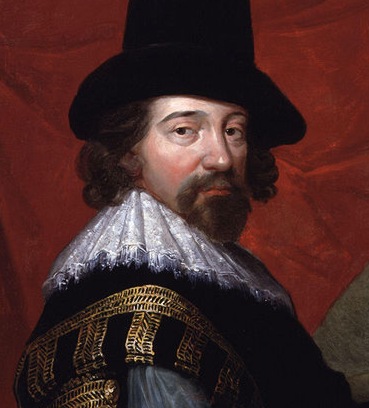 Darwin’s method was logical, a method popular during the Age of Enlightenment. However, this method is not aligned with the scientific testing principles developed by Francis Bacon (pictured right). Therefore, the theory of natural selection was never scientifically validated.
Although all copies of The Origin of Species were sold within 24 hours, its reception was mixed, as it is now. The Royal Society, founded on Baconian principles, never awarded Darwin any recognition for any of his published works.
“In the Air”
Interest in exploring the topic of evolution, however, emerged as a social phenomenon. In the words of Darwin, it was “in the air”. How the concept was viewed carried profound cultural implications. Capitalizing on the trend, Scottish publisher and geologist Robert Chambers (pictured left) brought together varying ideas about evolution.
Published anonymously, Vestiges of the Natural History of Creation was published in 1845. While Chambers’ ideas were favored by Radicals, reviled by Biblicists, and by Scientists, his publication became an international best seller. In the same year, reportedly, Prince Albert privately read the Vestiges to Queen Victoria.
The Vestiges enormous popularity caught Darwin by surprise., showing that the topic had captured the public’s interest. However, its wide-spread criticisms also delivered cautionary warnings. To separate the natural facts from fiction, the principles driving the Scientific Revolution ready.
Searching for a Mechanism
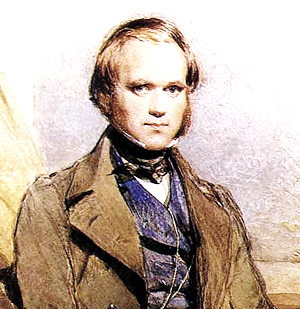 What the current evolution ideas were missing was a testable causal mechanism. At the time, advances in the physical sciences far exceed those in the life sciences. Darwin (pictured left) extended Aristotle’s “nothing in vain” logic and added a natural causal mechanism, noting in The Origin of Species–
“Aristotle, in his ‘Physicæ Auscultationes’ … applies the same argument… We here see the principle of natural selection shadowed forth.”
Introducing natural selection as the causative mechanism driving evolution opened the prospect of scientifically testing the theory. The natural selection concept transformed evolution into a scientifically testable theory.
However, two pillars of his theory, spontaneous generation and blending inheritance, drew the weight of the criticism. In The Origin of Species, although skeptical of spontaneous generation, Darwin never ruled it out. However, in 1862 by French naturalist, Louis Pasteur (1822–1895) experimentally falsified the theory.
Blending inheritance was a popular inheritance theory in the nineteenth century, Interestingly, Darwin was skeptical of the theory, noting –
“If you cross two exceedingly close races or two slightly different individuals of the same race, then, in fact, you annul and obliterate the differences.”
However, Darwin never ruled blending inheritance out, either. Conflicted over how inheritance works, Darwin simply noted –
“The laws governing inheritance are, for the most part, unknown.”
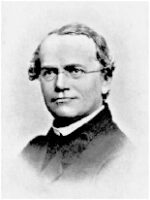 At the time, advances in understanding inheritance discovered by Gregor Mendel (pictured right), a contemporary of Darwin, was largely ignored, even by Darwin. Without alternative explanations for spontaneous generation and blending inheritance, Darwin’s theory, known as Darwinism, was largely ignored.
However, by the end of the nineteenth century, the re-discovery of Mendel’s inheritance model rescued Darwin’s theory. By the 1930’s, Darwin’s theory was popular again, becoming known as neo-Darwinism
Twentieth Century
Early Developments
Neo-Darwinism was an integration of Darwinism with Mendel’s inheritance theory. An operational framework for a modern scientific theory of evolution was emerging. In 1942, Julian Huxley introduced a synthesis of natural selection and Mendelian genetics, and population genetics into a mathematical framework in his 1942 book, Evolution: The Modern Synthesis.
The molecular foundation of this theory was driven by the “central dogma of molecular biology,” advanced by the co-discoverer of the DNA molecule, Francis Crick, stating –
“The central dogma of molecular biology deals with the detailed residue-by-residue transfer of sequential information. It states that such information cannot be transferred back from protein to either protein or nucleic acid.”
The framework for a scientifically testable theory of evolution was incrementally emerging.
Gene-Centric Views
Through the mid-late twentieth century, the emerging Genomic Revolution continued build on Frick’s central dogma. Abstract gene-centric views of evolution began their development in the mid-century. By integrating population genetic models of the modern synthesis, the gene’s-eye view takes the gene to be the central unit of selection in evolution.
The view was popularized by George Williams‘s Adaptation and Natural Selection (1966) and Richard Dawkins‘s best seller The Selfish Gene (1976). According to Dawkins —
“If we allow ourselves the license of talking about genes as if they had conscious aims, always reassuring ourselves that we could translate our sloppy language back into respectable terms if we wanted to, we can ask the question, what is a single selfish gene trying to do?”
Conflicting Views
Evolution scientists, Stephen J Gould and Niles Eldredge, introduced the concept of Punctuated Equilibrium. Their concept updated Darwin’s theory to account for the sudden appearance of species in the fossil record.
The concept of Punctuated Equilibrium, however, undermines Darwin’s principle concept of new species emerging by adaptation slowly over long time periods. But emerging conflicting views of evolution extend beyond Punctuated Equilibrium, they now even include the Modern Synthesis theory of evolution.
Twenty-First Century Challenges
By the early twenty-first century, as advances in biotechnologies continued to discover nature’s unsuspected molecular secrets, revisions to the modern synthesis theory became increasingly inescapable. As Massimo Pigliucci (pictured right), professor of philosophy at the City College of New York, explained –
“Molecular processes clearly demolish the alleged central dogma.”
Prior to Charles Darwin’s 150-year birthday celebrations in 2009, international evolutionary scientists began meeting to develop a scientific consensus on the theory of evolution. Since then, these forums have only highlighted why a unifying consensus on biological evolution has become increasingly improbable.
Huffington Post journalist, Suzan Mazur asked Eugene Koonin, head of the Evolutionary Genomics Group, National Center for Biotechnology Information, National Institute of Health –
“Why is it so difficult to pull together the most compelling ideas in evolutionary biology and come up with an approximate understanding of how it all works?”
Koonin answered –
“The public is already extremely skeptical about the value and the scientific nature of evolutionary biology… The genomic revolution… effectively overturned the central metaphor of evolutionary biology, the Tree of Life.”
Royal Society
 The last consensus convention of evolution scientists was hosted by the Royal Society in London in 2017, entitled Evolution 2.0. Science editor for the Financial Times, Clive Cookson, covering the event reported –
“Evolution 2.0 is a sign of a shifting emphasis in biology from regarding life primarily as a chemical system to looking at the flow of information.”
To date, no scientific organization has developed a consensus on the scientific validity of evolution based on biology or information. How life emerged remains one of the universe’s greatest mysteries.
Theory of Evolution Timeline is a subcategory of Theory and Consensus.
Darwin Then and Now is an educational resource on the intersection of evolution and science, highlighting the ongoing challenges to the theory of evolution.
Move On
Explore how to understand twenty-first-century concepts of evolution further using the following links –
- The Understanding Evolution category showcases how varying historical study approaches to evolution have led to varying conclusions. Subcategories include –
- Studying Evolution explains how key evolution terms and concepts have changed since the 1958 publication of The Origin of Species.
- What is Science explains Charles Darwin’s approach to science and how modern science approaches can be applied for different investigative purposes.
- Evolution and Science feature study articles on how scientific evidence influences the current understanding of evolution.
- Theory and Consensus feature articles on the historical timelines of the theory and Natural Selection.
- The Biography of Charles Darwin category showcases relevant aspects of his life.
- The Glossary defines terms used in studying the theory of biological evolution.