by Richard William Nelson | Jul 24, 2012
 Deciphering evidence for sea star evolution has long intrigued biologists. To explore speciation between two similar-looking sea stars, Jonathan Puritz (pictured below) of the Institute of Marine Biology at the University of Hawaii coordinated a research team to correlate the genetic and geographic differences between two Coral Sea species.
The team’s report, entitled “Extraordinarily rapid life-history divergence between Cryptasterina sea star species,” was published last week in the Proceedings of the Royal Society.
Continue Reading
by Richard William Nelson | Jun 26, 2012
Clues from fossilized mating turtles (pictured left) point to an enormous and sudden geological event. In last week’s edition of Biology Letters published by the Royal Society, Walter Joyce (pictured right) of Geosciences at the University of Tübingen in Germany.
The letter, entitled “Caught in the act: the first record of copulating fossil vertebrates,” updates information on the fossilized turtles discovered 30 years ago.
ABC News, BBC News, National Geographic, New York Daily News, MSNBC, FOX News, and Nature and Science journals featured the story, an unprecedented finding.
Continue Reading
by Richard William Nelson | May 29, 2012
Before the publication of The Origin of Species, speculating on the possibility of life originating naturally had long been a fascination. However, neither Charles Darwin nor the Modern Synthesis theory of evolution nor the Miller–Urey experiment provides any probable clues.
In the letter to J.D. Hooker in March 1863, Darwin privately expressed his disdain for addressing the topic, declaring —
“It is mere rubbish thinking at present of the origin of life.”
Continue Reading
by Richard William Nelson | May 22, 2012
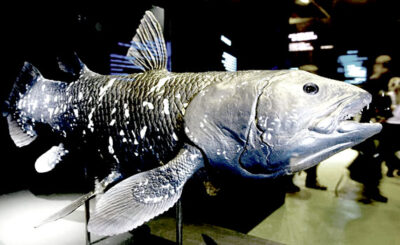
Andrew J. Wendruff and Mark V. H. Wilson of the University of Alberta added a new dimension to the ongoing coelacanth saga this week in the paper “A fork-tailed coelacanth, Rebellatrix divaricerca,” published in the Journal of Vertebrate Paleontology.
In the paper, Wendruff and Wilson present a newly discovered coelacanth species found surprisingly on the rocky slopes of the Canadian Rockies, British Columbia.
The species named Rebellatrix divaricerca means “rebel coelacanth (with a) forked tail.” Far different from today’s Indian Ocean coelacanths, these ancient rebel fast-swimming predators further undermine attempts to develop a cohesive coelacanth evolution saga.
Continue Reading
by Richard William Nelson | Apr 3, 2012
The sequence of biological events leading to hominin locomotion has long intrigued evolution scientists.
Last week, the journal Nature reported on a hominin-like foot discovered in Eastern Africa.
Entitled “A new hominin foot from Ethiopia shows multiple Pliocene bipedal adaptations,” the finding raises questions about the evolution of hominin locomotion.
Continue Reading

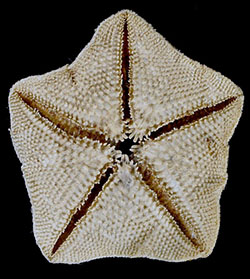 Deciphering evidence for sea star evolution has long intrigued biologists. To explore speciation between two similar-looking sea stars, Jonathan Puritz (pictured below) of the Institute of Marine Biology at the University of Hawaii coordinated a research team to correlate the genetic and geographic differences between two Coral Sea species.
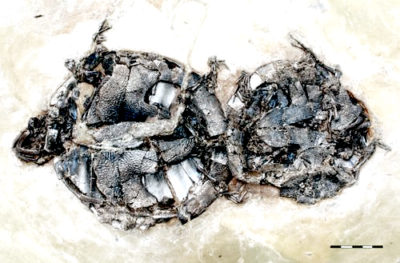 Clues from fossilized mating turtles (pictured left) point to an enormous and sudden geological event. In last week’s edition of
  Before the publication of
  Andrew J. Wendruff
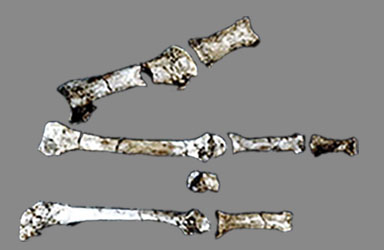 The sequence of biological events leading to hominin locomotion has long intrigued evolution scientists.