 Scientific methods for dating the time frames of Earth’s biosphere are far more complex than the dating of a fossil. When scientists radiometric date a fossil, they have an isolated, bounded object. However, the time frames of Earth’s biosphere are a composite of multiple independent, yet interacting biological, geological, and astronomic factors.
Scientists use empirical reasoning to radiometrically date a fossil, but dating Earth’s biosphere requires epistemic reasoning. With epistemic reasoning, researchers work with assumptions, abstractions, probabilities, and uncertainties, rather than direct empirical observation.
In other words, epistemic reasoning addresses what scientists cannot observe directly and explicitly incorporates uncertainty into their conclusions.
The Beginning
Scientists anchor the dating of Earth’s biosphere to Earth’s origin, about 4.54 billion years ago. Modern science treats a beginning in time as one of its most secure conclusions, and that conclusion underpins estimates of Earth’s age.
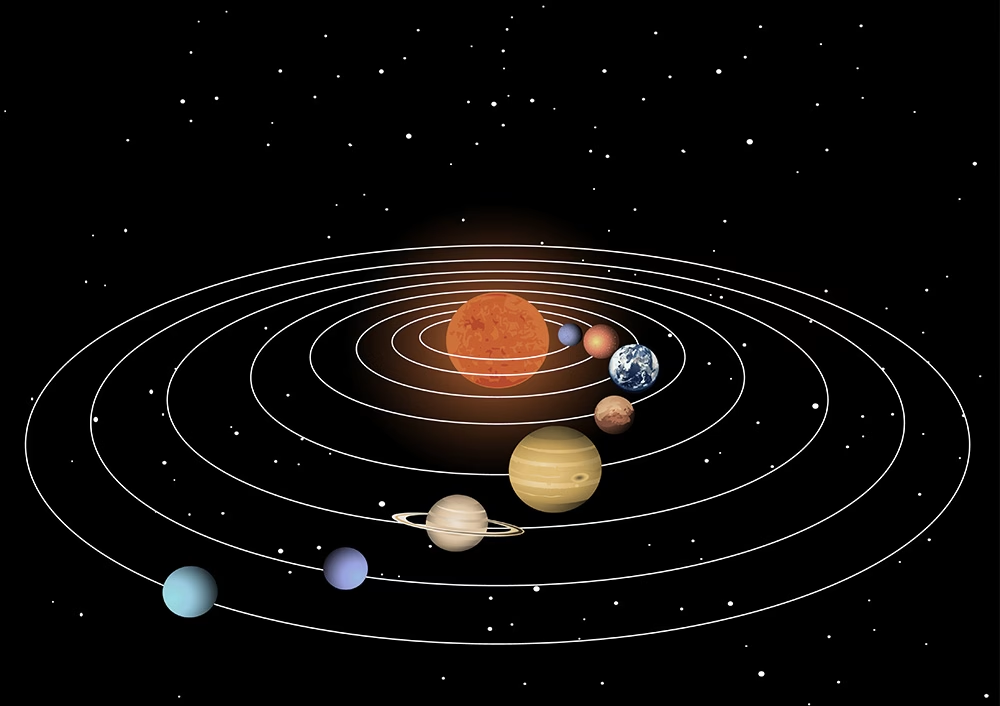 A single mathematical model can describe the beginning of our solar system, but estimating the age of Earth’s biosphere requires integrating many diverse—and often unknown—physical and biological factors, each with distinct principles and assumptions.
As a result, scientists must integrate multiple lines of evidence that rely on different inferential logics and carry different levels of uncertainty.
Scientific Consensus
 Scientific organizations such as NASA, the American Geophysical Union, and the American Association for the Advancement of Science issue consensus statements when empirical, falsification‑based evidence converges. These organizations concur that Earth is about 4.54 billion years old, based on radiometric dating.
However, no single physical law governs Earth’s biosphere, and biosphere dating does not share a unifying mathematical model, common inferential structures, or falsification‑based testing across methods. As a result, scientific organizations have not developed a framework that integrates distinct lines of evidence into a unified approach to biosphere dating.
Lines of Evidence
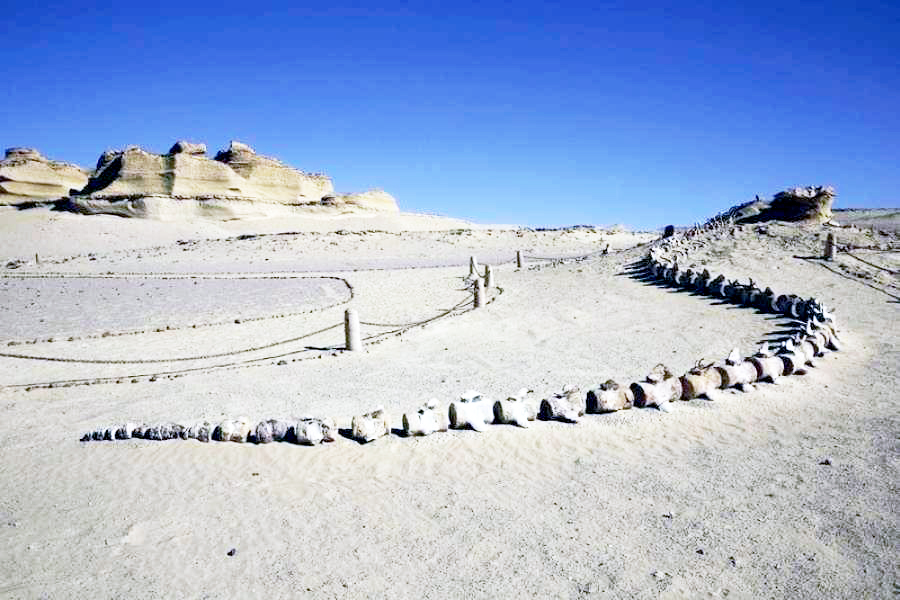 The complicating factor in dating is the heterogeneous nature of Earth’s biosphere, from inorganic elements to complex reproductive systems. Since the networks of each line are partially independent yet partially interdependent, trials of numerous approaches have yet to yield any consistent unifying time frame ages.
These heterogeneous lines of evidence continue to stymie efforts to develop a consensus framework for scientifically studying the age of Earth’s biosphere. Studying the age of Earth’s biosphere has moved beyond the deductive and inductive reasoning principles of the Scientific Method and incorporates epistemic reasoning.
Epistemic Reasoning
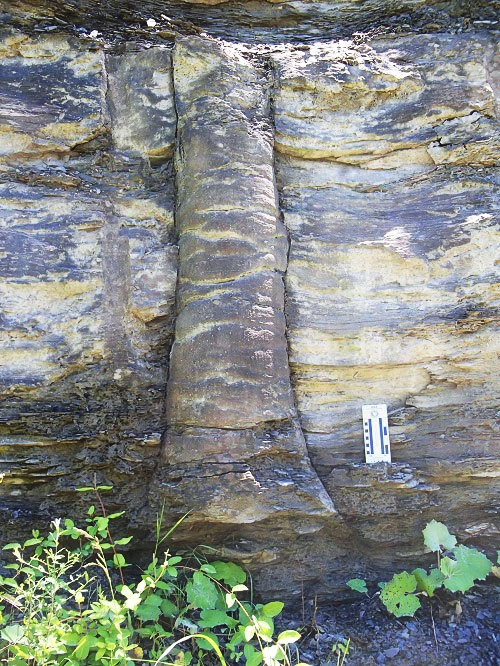 Epistemic reasoning starts with a belief or proposition, independent of any specific empirical evidence. The framework of epistemic reasoning differs from deductive and inductive reasoning, since it is not confined to formal logic or empirical generalization. Instead, it evaluates the justification of beliefs by integrating empirical evidence with conceptual, inferential, and methodological considerations.
In historical science, this type of reasoning extends beyond what data alone can determine, allowing scientists to assess coherence, weigh uncertainties, and justify conclusions. Epistemic reasoning allows for the synthesis of multiple lines of perceptions, inferences, and reasonings to understand the history of Earth’s biosphere.
However, since the integration of these processes may not be testable, epistemic reasoning introduces varying measures of uncertainty. Consequently, twenty-first-century scientific organizations have refrained from issuing a consensus framework for dating Earth’s biosphere.
Uncertainties
In the pursuit to understand the historical time frames of Earth’s biosphere, uncertainties arise stemming from a range of methodological elements, including – 
- Definitions and Conceptual Frameworks
Terminological Ambiguity: Terms including “stage,” “epoch,” and “event” have different meanings across disciplinary contexts (e.g., paleontology vs. sedimentology).
Boundary Criteria: The definition of boundaries (e.g., base of the Cambrian) hinges on biostratigraphic markers that are not globally synchronous.
Circularity Risk: Definitions can rely on fossil assemblages that are themselves dated using the very frameworks they help construct.
- Measurements
Unit Inconsistencies: Differences in isotopic standards, decay constants, or calibration curves lead to divergent age estimates.
Precision vs. Accuracy: High-precision measurements (e.g., Uranium-Lead dating) can be inaccurate when underlying assumptions (e.g., closed system behavior) are violated.
- Regional Variations
Diachronous Markers: Fossil taxa or lithological features appear at different times in different regions due to ecological or depositional factors.
Regional Variations: Stratigraphic markers—like fossil assemblages or lithological features—vary dramatically across continents and between studies.
Facies Dependency: Lithostratigraphic units are facies-dependent, complicating global correlation.
- Dating Methods
Chronostratigraphy vs. Geochronology: Rock-based and time-based frameworks diverge, especially in fossil-poor intervals.
Technical Methods: The types of technical methods, including radiometric dating, magnetostratigraphy, chemostratigraphy, molecular dating, and astrochronology, vary across studies and evidence types.
Calibration Conflicts: Fossil calibration points used in molecular clocks often conflict with radiometric dates, raising questions about which framework to privilege.
Technical Challenges: As new technologies emerge, the parameters of the independent variables must be recalibrated and standardized. Importantly, the new data can be incompatible with older technologies.
This heterogeneity of evidence complicates a scientific integration of these into a single, coherent, chronologically ordered dating model of Earth’s biosphere.
Biosphere Dating Models
To date, an official consensus of Earth’s biosphere time frames has not been published by any scientific organization for any of the following natural events —
These organizations include —
-
- NASA
- American Geophysical Union (AGU)
- American Association for the Advancement of Science (AAAS)
- U.S. Geological Survey (USGS)
- International Commission on Stratigraphy (ICS)
- National Academies of Sciences, Engineering, and Medicine (NASEM)
The Earth’s biosphere time frames are assumed to be synchronized with the Earth’s geological time frames. The International Commission on Stratigraphy (ICS) is recognized as the leading scientific organization for defining, managing, and publishing currently understood geological time frames.
Geological Time Frames
 The ICS is science’s largest and oldest scientific geological organization within the International Union of Geological Sciences (IUGS). ICS’s current chart (pictured left) was developed by the International Chronostratigraphic Chart (ICC).
Updated charts with a geochronological history of Eons (Eonothem), Eras (Erathem), Periods (System), Epochs (Series), and Stages (Age) are published regularly. These time frames serve as an interface to integrate with the work of geologists, paleontologists, and Earth scientists.
The chart commission is directed by 17 subcommissions, each responsible for a specific period of geological time, and is overseen by 6 executive officers. However, the ICS charts, the latest consensus version was published in 2024, are not integrated with any other published biospheric time frames.
Currently, the only consensus on managing geological uncertainties is to perform “ongoing revisions.” The ICS includes the following disclaimer on its charts –
“Numerical ages are subject to ongoing revision and do not define units…”
The U.S. Geological Survey (USGS) publishes diagrams showing presumed stromatolite ages, oxygenation events, and fossil transitions. However, these have not been formally validated as Earth’s official history of biosphere time frames.
Since the aging of Earth’s biosphere is not governed by a single physical law, dating Earth’s biosphere is vastly more complex and uncertain than estimating Earth’s age.
Therefore, there is currently no consensus among modern science organizations on methods of study or the time frames of Earth’s biospheric history.
Time Frames of Earth’s Biosphere
The prospects of developing a scientifically testable time frame for Earth’s biosphere are low with the current scientific tools and conceptual frameworks. The reason is the structure of the evidence, not merely technical.
 Validating proposed time frames for Earth’s biosphere history remains speculative. The twenty-first-century evidence is compatible with the Genesis account written by Moses –
“In the beginning God created the heaven and the earth… And God saw every thing that he had made, and, behold, it was very good. And the evening and the morning were the sixth day.”
Dating Earth’s Biosphere is a subcategory of the Fossil Record.
More
Subcategories of the Fossil Record include
Darwin Then and Now is an educational resource on the intersection of evolution and science, highlighting the ongoing challenges to the theory of evolution.
Move On
Explore how to understand twenty-first-century concepts of evolution further using the following links –
-
- Understanding Evolution category showcases how varying historical study approaches to evolution have led to varying conclusions. Subcategories include –
- Studying Evolution explains how key evolution terms and concepts have changed since the 1958 publication of The Origin of Species.
- What is Science (current category) explains Charles Darwin’s approach to science and how modern science approaches can be applied for different investigative purposes.
- Evolution and Science feature articles on how scientific evidence influences the current understanding of evolution.
- Theory and Consensus feature articles on the historical timelines of the theory and Natural Selection.
- The Biography of Charles Darwin category showcases relevant aspects of his life.
- Glossary defines terms used in studying the theory of biological evolution.
- Understanding Evolution category showcases how varying historical study approaches to evolution have led to varying conclusions. Subcategories include –